When coexistence becomes rot, conflict becomes surgery.
Foreword – In the Shadow of War
What began as a civilizational split has become a generational war of identity, ideology, and truth. This is not just about borders. It’s about the soul of a region—and what it takes to truly end a conflict.
Another round of bloodshed. Another funeral for a soldier who didn’t start the war but paid the price for it. Another family shattered by a conflict older than their own lineage.
As India and Pakistan face yet another tense confrontation, it stretches across borders. It manifests in propaganda and occurs via diplomacy. At times, it erupts through brutal violence. It’s easy to be consumed by rage. But beyond that rage lies a deeper sadness. Because war, at its core, is not strategy. It is suffering. It is the extinguishing of potential, of peace, of lives that never got a chance to bloom.
A child can be killed in crossfire. A soldier is ambushed at night. A family will be displaced by shelling. The horrors of war are always personal. They are always devastating.
It is in this moment of grief, anger, and helpless introspection that I write this piece. Not to justify war. Not to vilify a people. But to provoke a thought:
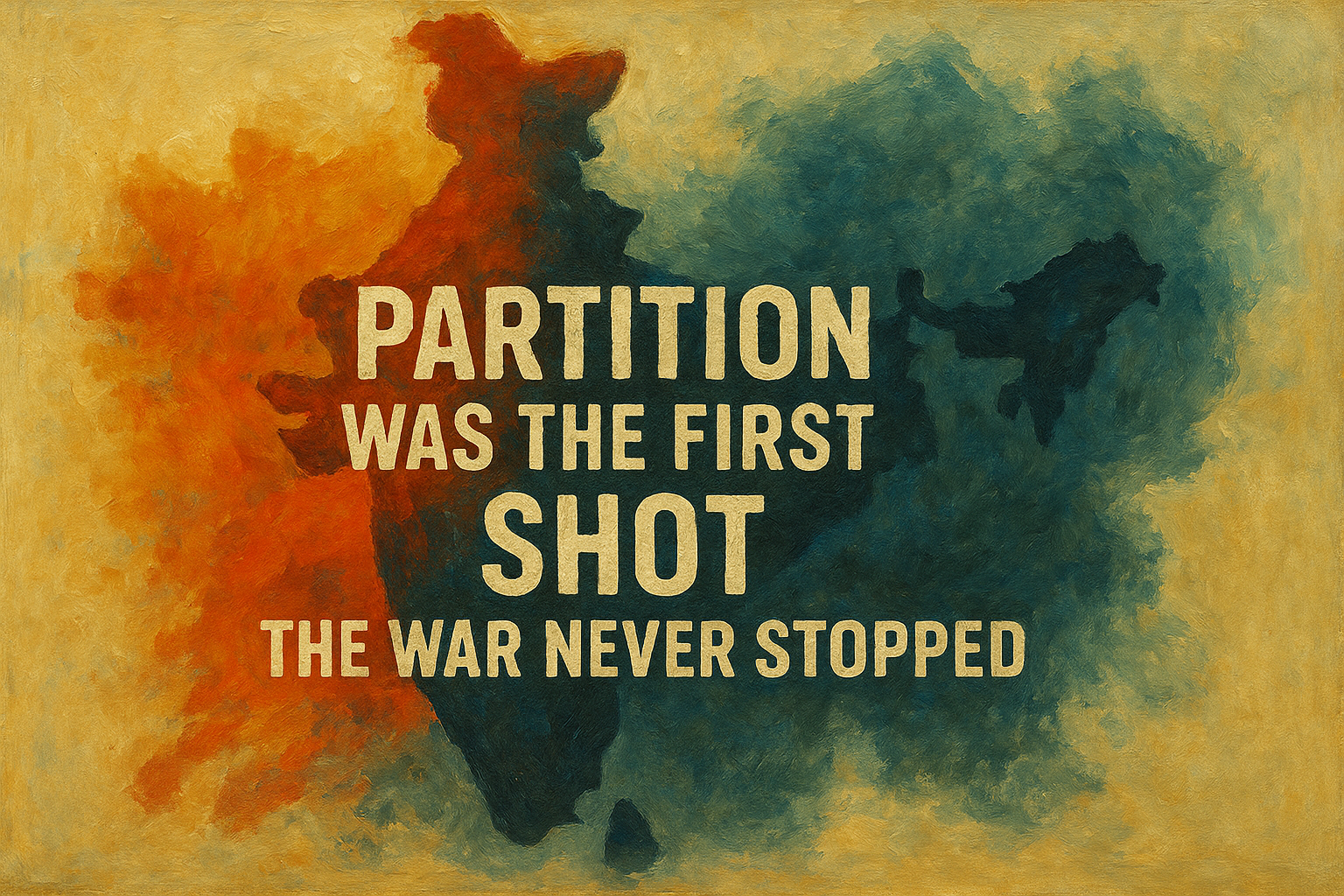
What if the separation we keep lamenting was, in fact, our salvation? What if Partition—flawed and tragic as it was—spared us a greater, slower, more poisonous demise?
In the annals of South Asian history, few events rival the emotional, cultural, and political rupture of the 1947 Partition. It tore families apart, carved nations from bloodied soil, and ignited the birth of two sovereign states—India and Pakistan. For decades, historians, intellectuals, and artists have lamented the tragedy of a divided subcontinent. They romanticize a “what could have been” vision of a united, peaceful region.
But romanticism is not realism.
Today, with the benefit of hindsight, one is forced to ask amid the ceaseless echoes of cross-border tensions. Proxy wars and ideological extremism persist. Was the separation not a necessary course correction? Was it not a preemptive firewall between two fundamentally incompatible visions of nationhood?
What follows is not history. It is reflection. It is the uncomfortable confrontation of a truth we’ve long resisted. Sometimes, to preserve a body, you must amputate the infected limb.
About the Author
Sumir Nagar is a writer, speaker, and strategist. He is also a seeker with over three decades of global experience. This experience spans leadership, governance, and digital transformation. He has worked on four continents, held senior roles in global financial institutions, and mentored startups through crisis and reinvention.
But beyond boardrooms and metrics, Sumir is a deep observer of human nature, cultural psychology, and civilizational narratives. His writing weaves together personal reflection, historical insight, and unapologetic truth-telling—often challenging popular beliefs to expose what lies beneath.
He is the author of The Fire Beneath Stillness, a collection of original quotes on selfhood, resilience, and awakening. He is currently writing The Matrix of Six, a groundbreaking exploration of the six forces that shape all human decisions.
India, despite its flaws, continues to strive for a pluralistic identity. In contrast, Pakistan was born of an idea rooted in religious exclusivity. The two-nation theory justified its creation. It sowed the seeds of perpetual suspicion. This affected minorities, dissent, and eventually, its own people.
Pakistan did not emerge from a unifying vision—it emerged from division. It was conceived not to bring together, but to break away. And when a country is birthed from separatism, that foundational fracture becomes a part of its national DNA.
Over the decades, this has played out in stark, painful ways:
The violent breakup with East Pakistan (now Bangladesh) in 1971.
Constant friction with ethnic groups—Sindhis, Balochis, Pashtuns—who feel marginalized under dominant military rule.
The systemic persecution of minorities like Ahmadis, Hindus, Christians, and Shias.
An obsession with defining itself in opposition to India rather than evolving an independent identity.
A nation founded on “not being India” has never learned to simply be itself. And that identity crisis bleeds into policy, society, education, and diplomacy.
The Civilians Are Not Always Innocent
But what’s more alarming is not just the military’s stranglehold over democracy or the state’s long-documented support for extremist groups. It’s the uncomfortable question: How long can we keep blaming just the establishment?
Because terrorism, radicalism, and religious intolerance don’t survive in a vacuum. They require fertile soil—ideological approval, passive complicity, and at times, outright celebration. That soil, disturbingly, often lies within the civilian psyche.
It’s easy—and emotionally convenient—to draw a line between the actions of the army and the sentiments of the population. But recent events and popular reactions, especially during conflicts, suggest a chilling alignment.
Videos of captured Indian soldiers are circulated with glee. Terrorists are hailed as martyrs. Textbooks glorify jihad and rewrite history. It becomes clear that the problem is not isolated to the barracks—it festers in classrooms, living rooms, and tea stalls.
No nation can be perpetually misled unless it is willing to be. Propaganda only works when it reinforces existing belief systems. And belief systems only persist when society, en masse, refuses to confront them.
The Blessing in the Pain
Given all this, one must wonder—what if Partition had not happened? What if the ideological cancer that festers across the border had instead metastasized within a single, united nation?
Would we be fighting insurgencies in ten more states? Would India’s fragile secular fabric have survived the weight of relentless radicalization?
Perhaps Partition was not just a tragedy—it was a surgical amputation. A painful, violent one—but also a life-saving one. It drew a line between two dreams—one of inclusivity, and the other of identity built through exclusion.
The Mirror We Refuse to Hold
This is not a call to hatred. Nor is it an indictment of every Pakistani citizen. There are voices of peace, of reason, and of resistance across the border—and they deserve support.
But truth must not be silenced by the fear of being labeled politically incorrect. If terrorism thrives, it is because entire systems—state, society, and sentiment—allow it to. If people repeatedly choose those who fuel extremism, then their collective conscience is not above scrutiny. Their conscience must be examined when they protect or cheer these individuals.
India, for all its problems, still houses every religion. It debates, sometimes ferociously, the ideas of nationalism and dissent. Its citizens protest, vote governments out, challenge authority. That’s democracy. That’s plurality. And that’s a nation that, at its core, still believes in co-existence.
The Great Uprooting – What Drove People to Pakistan?
In 1947, millions of Indian Muslims faced a personal crisis: to stay or to leave. The newly formed Pakistan offered a promise wrapped in emotion, identity, and ideology.
Some saw it as a clean slate—a chance to escape perceived marginalization and build a new Muslim-majority nation.
Others were influenced by rhetoric that portrayed Pakistan as a promised land.
There were also those who moved out of fear. They were led by the belief that staying back would make them second-class citizens.
Ironically, many didn’t foresee that Pakistan would fall prey to military dominance. It quickly succumbed to internal fragmentation. This situation betrayed the very promises that drove the migration.
But here’s the uncomfortable truth: not all were passive victims of propaganda. Many actively chose Pakistan out of deep-rooted religious identity and the allure of a theocratic homeland.
Economic Contrast – Two Paths, Two Outcomes
At the time of independence in 1947, Pakistan was not at an economic disadvantage. It had fertile agricultural lands, a smaller but manageable population, and access to trade via ports. But seven decades later, the tables have not just turned—they’ve been shattered.
India’s Rise
Today, India is the fifth-largest economy in the world.
It is a hub for global services, IT, pharmaceuticals, and space exploration.
It continues to reinvest in education, infrastructure, and innovation—despite its internal challenges.
Pakistan’s Spiral
Pakistan has gone through multiple military coups, international bailouts, and economic crises.
Foreign investment is scarce, inflation is rampant., and civil.
Civil liberties are frequently curtailed in the name of security and nationalism.
This isn’t just a difference in GDP figures—it’s a reflection of two philosophies of nationhood:
One that believes in evolving, absorbing, and progressing.
Another remains trapped in a self-imposed identity crisis. It is unable to move past the wounds of Partition. The paranoia of perceived enemies persists.
And crucially, the military siphons a significant portion of national resources, prioritizing defense over development. But defense from whom? There is a great delusion that Pakistan must perpetually prepare itself against Indian aggression.
But let’s be honest—no one in their right mind wants to annex Pakistan.
India has never sought expansion. Every conflict with Pakistan has been a response, not an initiation. And even strategically, Pakistan has nothing to offer—no economic assets, no global leverage, no intellectual capital that justifies conquest.
The military expenditure, then, is not about defense. It is about internal control. A poor country arming itself against an imagined enemy is not strategy. It is state-sponsored delusion.
A Pawn in Global Games – The Weakness That Was Engineered
One cannot fully understand Pakistan’s condition without acknowledging the role of powerful external actors. For decades, these external actors have used the nation as a geopolitical pawn. They have not respected it as a sovereign partner.
During various regional conflicts and strategic rivalries, Pakistan became a tool of convenience. It was never nurtured for internal strength, institutional stability, or long-term growth. It was shaped and incentivized to serve external interests. It was often pressured as a launchpad, a buffer, a bargaining chip, or a containment tool.
And for that role to be fulfilled, Pakistan had to remain strategically unstable. It needed to be strong enough to be useful, but weak enough to be controlled.
In such an arrangement, democracy was inconvenient. Elected leaders were unpredictable. Civil society was a liability. What worked best were unaccountable power centers—those who could execute decisions without debate, transparency, or delay.
The military leadership filled that vacuum. They became the consistent face of state power. They outlasted politicians and outmaneuvered reformers. They also operated as gatekeepers for external agendas.
The result? Pakistan became a country that borrowed its ideology, its weapons, its alliances, and often, its very sense of purpose.
This dependency crippled the nation’s ability to forge a grounded, self-defined identity. It ruled on borrowed pride, sustained by strategic illusions. And now, the costs are unraveling.
It was not just the people who were betrayed. It was the idea of Pakistan itself.
The Cracks Within – A Nation Waiting to Collapse Further
While the outward hostility of Pakistan’s establishment continues, cracks are growing inside the country itself—particularly among its youth.
There is a simmering unrest. An undercurrent of frustration. More and more Pakistanis—especially the educated, connected, urban young—are beginning to question the narrative they’ve been fed for decades. That India is the eternal enemy. That Kashmir is their birthright. That military supremacy is national pride. That the economy is suffering because of global conspiracies.
That spell is wearing thin.
They see India’s space missions, digital innovations, infrastructure growth, and expanding global influence. And though they may never openly praise India, they do grudgingly admire its momentum. They know where the future is heading. It isn’t in the direction Pakistan is being dragged by its generals and clerics.
But here’s the tragic reality:
They are not yet strong enough to change the system.
The voices of reason, of reform, of peace—they exist. But they are scattered, surveilled, and silenced. The masses remain too conditioned, too fearful, or too economically dependent on the military-industrial establishment to challenge it head-on.
There may one day be a popular uprising, a new political consciousness, a leader who rejects hate and separatism. But that day is not today. Nor is it tomorrow.
Pakistan hasn’t hit rock bottom yet. There is more collapse, more delusion, more pain left in its spiral before the mirror becomes unavoidable.
And the spiral may be slow or sudden. It could decay over decades, or collapse overnight under the weight of its contradictions. Only time will tell.
India – A Civilization of Absorption Now Turning Inward?
India has never been just a nation—it has always been a civilization. A layered, breathing, contradictory, and evolving civilization that didn’t merely survive invasions and migrations—it absorbed them.
Through millennia, India became home, refuge, and crucible for countless communities. Not through enforced uniformity, but through a sophisticated, self-assured pluralism that allowed difference to not just exist—but flourish.
And yet, here’s the paradox:
India was never truly united in the way modern nations are imagined today. Before the British unified it under colonial rule, the subcontinent comprised princely states, tribal regions, empires, and autonomous kingdoms. Each had its own culture, rulers, and religion. The idea of “India” as one political unit is a relatively recent construction. Geography or governance did not bind us together. What united us was a deeper civilizational thread. It tolerated, absorbed, and harmonized difference over millennia.
The Greeks arrived with Alexander. Some fought, many stayed. They influenced Indian art (Gandhara style), numismatics, and blended into Indian cosmology through syncretic interpretations of gods and heroes.
The Kushans and Mongols brought Central Asian ideas of governance, cavalry warfare, and artistic motifs. They didn’t erase India—they added to its palette.
The Mughals—perhaps the most debated—ruled large parts of India, yes. But their legacy includes Hindustani music, Indo-Persian literature, Mughal miniatures, architecture, fusion cuisine, and linguistic blending that created Urdu.
The Parsis, fleeing Islamic persecution in Persia, found safe harbor in Gujarat. To this day, their Zoroastrian fire temples burn undisturbed in Indian cities. This is a level of religious preservation rare anywhere else in the world.
Jews, Armenians, Chinese traders, Afghan Sufi mystics, British thinkers—all left their imprints. And the subcontinent, rather than being diluted, was deepened.
This was India’s true identity: A civilization so vast, so self-contained in spirit, that it could afford to be generous. A land that allowed multiple truths to co-exist. One that saw time as cyclical, not linear; truth as layered, not absolute.
From Trade to Infiltration: The Slippery Slope
What began as trade—mutual, beneficial, often respectful—slowly mutated into ideological imposition:
The Portuguese, the Dutch, the French, the British, the Mughals, and various Christian missions initially engaged with India for commerce. They sought alliances and influence. But over time, trade gave way to control, and control gave way to conversion—both religious and cultural. They:
Built forts under the guise of trade posts, which became the foundations of colonial expansion.
Interfered with local governance, pitting princely states against one another.
Imposed new laws, languages, land ownership models, and foreign education systems.
And perhaps most enduringly, planted the seed of religious superiority. This portrayed local faiths and ways of life as primitive, chaotic, or inferior.
This was no accident. It was a centuries-long plan, executed subtly, then overtly, until it took root in law, society, and psyche. Over time, India became a battleground of ideologies, not just armies.
So, What Changed? Why Are We Turning Inward?
That generous spirit now seems strained. Suspicion has replaced confidence. Identity is being reduced to a slogan. Diversity—once our strength—is increasingly seen as a threat. Why?
1. Post-Colonial Wounds Never Fully Healed
The colonial narrative wasn’t just physical—it was psychological. British policies of divide and rule, racial superiority, and historical distortion fractured the Indian psyche. They planted seeds of suspicion between communities that independent India tried to heal—but never fully could. Partition was the ultimate proof of that unresolved trauma.
2. The Cost of Centuries of Invasion
While India absorbed foreign influences, it also bore the brunt of brutal conquest, loot, temple destruction, forced conversions, and humiliation. Over time, a deep civilizational fatigue emerged. Historical bitterness deepened, especially among those who felt their identity had been too accommodating for too long. The current reassertion of cultural pride is, in part, a response to this long-suppressed pain.
3. The Rise of Reactive Nationalism
As global geopolitics grew more polarized, and as terrorism and border conflicts intensified, India began seeking a stronger, singular identity. Majoritarian politics rose. Social media echo chambers had a strong influence. A global wave of populism emboldened a rhetoric. This rhetoric framed inclusivity as weakness. It saw uniformity as strength.
What began as a push for cultural revival has, in parts, morphed into ideological defensiveness. It is no longer just about celebrating who we are—it is increasingly about defining who we are not.
4. The Anxiety of Rapid Modernization
India’s urbanization and digitization are happening at breakneck speed. In this hyper-modern context, people seek certainty and anchoring. Religion, identity, and heritage offer that stability. But when this anchoring is co-opted for political gain, it turns exclusionary.
5. The Trauma of Being Too Tolerant
There is a growing sentiment—valid in parts—that India’s tolerance has historically been taken for granted or exploited. That in its eagerness to accommodate, it allowed fractures to deepen unchecked. This has led to a reactionary stance: a need to draw firmer lines, assert boundaries, and reclaim space.
But What Are We Risking?
In hardening ourselves against historical hurt and modern threats, we risk losing the very soul of this civilization.
When we stop listening to dissent, we lose the ability to course-correct.
When we reduce “Indian-ness” to a checklist of symbols, we discard centuries of nuance.
When we pit one community against another to gain political mileage, we break the spine of unity.
India was not built by uniformity—it was built by synthesis. And if we now choose sameness out of fear, we betray the very essence of who we are.
A Personal Conflict – Between Absorption and Assertion
My upbringing and education have shaped me. I have a deep reverence for the inclusive fabric of India. However, I must acknowledge a shift I can no longer ignore.
I was raised on the philosophy of Sanatan Dharma. It is a worldview that celebrates multiplicity. It embraces paradox and sees the divine in all forms of existence. At its core, Sanatan Dharma doesn’t seek conquest—it seeks absorption. It doesn’t impose—it integrates. It doesn’t convert—it transforms by presence. It has survived millennia not through rigidity but through adaptability. Through the silent confidence that truth, when lived authentically, doesn’t need to shout.
Yet, I now find myself understanding—though not necessarily endorsing—why a backlash is taking place.
Perhaps after centuries of invasions, foreign rule, ideological imposition, and cultural dilution, the Indian psyche is simply exhausted. Perhaps a civilizational patience has run its course. The pendulum of tolerance may now be swinging in the opposite direction—toward assertion, boundary-setting, even aggression.
This is not just organic—it is manufactured.
The message of “Unity in Diversity” was once the soul of India’s national identity. It is being gradually replaced by more hardline narratives. These are not fringe slogans—they echo from the highest offices in the land. They travel through political speeches, school textbooks, television news, WhatsApp forwards, and university campuses. Over time, they indoctrinate.
Not through brute force—but through subtle repetition. By normalizing suspicion. By reshaping memory. By glorifying confrontation over conversation. This, too, is war—a war on perception.
And yet, there is a paradox in play. Even as India turns inward socially, it is exploding outward economically and geopolitically.
India has consistent GDP growth. It has a rising startup ecosystem. Additionally, it boasts a flourishing digital economy. India is no longer seen as the world’s back office, but as a center of innovation.
In space research, fintech, AI, and pharmaceuticals, Indian achievements are commanding global respect.
Politically, India is now unafraid to flex, to speak boldly on global forums, to assert its interests without apology.
And perhaps that is the subtext beneath this identity shift. Economic power breeds cultural confidence. When a civilization finally feels strong, it often chooses to redefine how it sees itself. It also redefines how it wants to be seen.
The risk, of course, is that in seeking to reclaim identity, we might overwrite the very ethos. This ethos made us worthy of admiration in the first place.
The Unavoidable Conclusion – Uprooting the Conflict at Its Roots
And so we arrive at the uncomfortable possibility. It’s a conclusion few dare to voice. Yet, many privately contemplate that this conflict may no longer be resolvable through diplomacy, dialogue, or gestures. What was once a border dispute has become a proxy war. It has now mutated into an existential divergence of identity, ideology, and nationhood.
If that’s the case, then perhaps there is only one way to truly resolve this long-standing regional fault line. It is through an eradication from the very roots. This eradication targets the systems, beliefs, and structures that perpetuate the conflict, not people.
But let’s be clear—what that entails is dangerous.
Such a process would not be surgical. It would be prolonged. Bloody. Emotionally corrosive. It would demand sacrifices on both sides—of lives, livelihoods, and illusions.
And even then, we must ask:
Will there ever be a clear victor? Will one flag finally wave over a silent battlefield, declaring peace once and for all?
History suggests otherwise.
Conflicts like these don’t end with parades or proclamations. They seep into soil, into memory, into bloodlines. The bereavement—whether personal or economic—doesn’t bring closure. It brings bitterness. And bitterness ferments into generational hatred.
A bombed school becomes a radical’s origin story.
A lost father becomes a young soldier’s vengeance.
An economic collapse becomes fodder for extremism.
And so the cycle renews.
Even in victory, there is no victory—only the illusion of settlement and the guarantee of emotional residue.
Which is why the real battleground is not the border—it is the psyche. Unless minds change, unless narratives are rewritten at the grassroots, no bullet can end what ideology keeps alive.
This is the sobering paradox of modern conflict: that to truly win, one must heal. And healing, unlike warfare, has no strategy. Only choice.
The Pendulum Always Swings
History is not a straight line. It is a pendulum—swinging from one extreme to another before finding its momentary balance.
And nowhere is this more visible than in religious sentiment, cultural behavior, and collective public reaction.
Societies move through cycles:
From radicalism to reform
From dogma to dialogue
From strict moral absolutism to liberal pluralism
And sometimes—tragically—back again
When a civilization feels wounded, it retreats into defensiveness. That defensiveness becomes identity. That identity becomes ideology. And ideology, left unchecked, becomes radicalization—not just of belief, but of behavior, laws, and daily interactions.
But the pendulum does not stay there forever. Eventually, people tire of conflict. Of moral fatigue. Of constant rage. A generation arises that questions, challenges, or simply refuses to carry old wounds.
This shift toward tolerance and inclusion is not weakness. It’s civilization healing from within.
And yet, even this newfound openness is vulnerable. A single act of violence, a cultural insult, a crisis—real or manufactured—and the pendulum swings back. Often faster. Often harder.
This is what we are witnessing across the region today. In both India and Pakistan, and across much of the world, the old pendulums are in motion again. Ideologies once buried are resurfacing. And the question we must ask is not just where we are—but where the swing will take us next.
Will it move toward reconciliation, truth, and strength through inclusion? Or will it snap violently toward fear, exclusion, and confrontation—dragging us back into yet another cycle of inherited anger?
The answer lies not in history—but in how we choose to interpret it.
Conclusion – The Blessing We Resisted, The Truth We Must Face
We were taught to mourn Partition as a tragedy—and it was. But perhaps we mourned the wrong thing. We mourned the breaking of land. But what we should’ve mourned was the incompatibility of ideas that forced that break in the first place.
Some unions were never meant to be. When the core values of two peoples diverge so completely, harmony is impossible. If one thrives on pluralism and the other on exclusion, keeping them tied together is not harmony. It’s hostage-taking.
Partition was not a failure of politics. It was a diagnosis of irreconcilable paths.
And perhaps, just perhaps, it saved India from a slow, soul-crushing corrosion. It spared it the fate of being dragged backward by forces that refuse to walk forward.
This is not triumphalism. It’s a reckoning. Because the greatest mistake we can make now is to become what we once resisted—intolerant, reactionary, and small.
The challenge before us is immense. We need to remain strong without becoming hard. We should be rooted without becoming rigid. We must lead without losing our soul.
Note from the Author
For most of my life, I believed that Partition was a grave mistake. It was a scar on the soul of India. I often cursed the leaders and decision-makers who allowed the birth of Pakistan. I wondered what possessed them to divide a civilization so deeply intertwined.
But time, history, and repeated betrayal have a way of clarifying truth. Today, I see that Partition was cruel. Yet, it may have been a surgical strike. This was not on land, but on ideology. A decisive cut to remove what would otherwise have festered within, corroding us from inside.
I take no joy in saying this. But truth is not about comfort—it’s about clarity.
And perhaps, it’s time we stop romanticizing unity at the cost of sanity.
— Sumir Nagar
Call to Action
If this article challenged your thinking or stirred something deeper, don’t let the conversation end here. If it made you see Partition—and the region—in a new light, continue the discussion.
Share it. With those who believe, those who question, and especially those who never dared to ask. Comment below. Your thoughts, your disagreement, your insights—they matter. Subscribe at www.sumirnagar.com to receive more reflective, unfiltered writing on truth, leadership, and the human condition. Follow@SumirTheSeeker on Instagram for more bold reflections, quotes, and video essays.
Truth only survives when it’s spoken aloud. Let’s speak.



Leave a Reply