
There is this quiet, collective and unsaid delusion operating across the global knowledge economy. It involves over 1.3 billion registered adults who log on, straighten their digital ties, and pretend that what they are participating in is an essential utility for professional advancement.
If Instagram, TikTok and X (formerly Twitter), are built on algorithmic micro-dopamine, aesthetic envy and toxic political outrage, LinkedIn has engineered a far more sinister currency, Performative Professional Virtue.
The ones who signed up a long time ago (like myself) and even the ones who continue to sign up today, believe, at the time of signing up, that it is a networking site, digital résumé, and a digital town square for corporate ambition.
But if you strip away the corporate newspeak and inspect its underlying mechanics, a sharp structural question emerges.
The Cathedral of Modern Synergy
For starters, let’s look at the numbers.
- LinkedIn has 1.3 billion members across 200 countries (LinkedIn, 2026).
- 4 out of 5 LinkedIn members drive business decisions.
- 87% of B2B marketers use LinkedIn; 97% use it for content marketing.
- LinkedIn’s annual revenue has crossed $19 billion, with 12% year-over-year growth in the most recent reported quarter.
- 49 million people search for jobs on LinkedIn every week.
- LinkedIn’s audience has 2x the buying power of the average web audience.
- 53% of US adults earning $100K+ use LinkedIn (Pew Research, 2025).
- Video watch time on LinkedIn is up 36% year-over-year (Q4 2025).
- LinkedIn Premium revenue crossed $2 billion annually in Q2 2025.
- 7 people are hired through LinkedIn every minute.
In my opinion, these numbers paint a picture of Mass Produced Corporate Absurdity.
Is LinkedIn merely another social media platform, or has it devolved into something far more absurd—a pay-to-play panopticon of corporate anxiety?
The Algorithmic Trap – Dopamine Engine in a Two-Piece Suit (Psychology 101)
At its architectural core, LinkedIn is now indistinguishable from mainstream social networks.
It relies on the exact same psychological hooks. Infinite scroll feeds (doom-scrolling), notification loops, vanity metrics, and engagement-baiting algorithms.
The primary difference lies in the garb. Where TikTok offers teenagers dancing, LinkedIn offers executives engaging in performative vulnerability.
The “Humblebrag” Archetype
Consider the structural anatomy of the quintessential viral LinkedIn post. As opposed to, here is my professional profile, we have graduated to:
- The Manufactured Catastrophe: “I was fired this morning at 6:00 AM.”
- The Stoic Pivot: “As I sat on my kitchen floor, staring at my cold black coffee, I realized this wasn’t a setback. It was a gift.”
- The Absurdist Epiphany: “Here are 7 profound lessons my golden retriever taught me about agile product management and scalable leadership.”
- The Algorithmic Trap: “Agree? Thoughts below 👇”
Only a tiny minority of users actually post content on the feed—a mere 3% of users post more than once a week, yet that fraction dictates the narrative for hundreds of millions of passive lurkers.
It is a system built to convert quiet professional insecurity into noisy, content-driven posturing.
The platform is a great way to exploit corporate insecurity, converting workplace anxiety into content creation. and is also a great way to pander to the ego market.
The Monetization of Anxiety (Economic & Market Dimension)
The Corporate Panopticon
Unlike traditional platforms where you hide from your employer, LinkedIn is the platform where your employer, your prospective boss, and your high school rivals are all watching.
The B2B Influencer Industrial Complex
The rise of the “Thought Leader” who hasn’t managed a team or closed a deal in six years, but sells $2,000 bootcamps on “How to Grow Your Personal Brand”.
LinkedIn Sales Funnel
Then there are myriad “consultants” who promise to teach you to use your LinkedIn profile to generate a “funnel” for sales leads. I can only wonder if these techniques, tools and utilities actually do generate a viable sales funnel that actually convert to actual revenue.
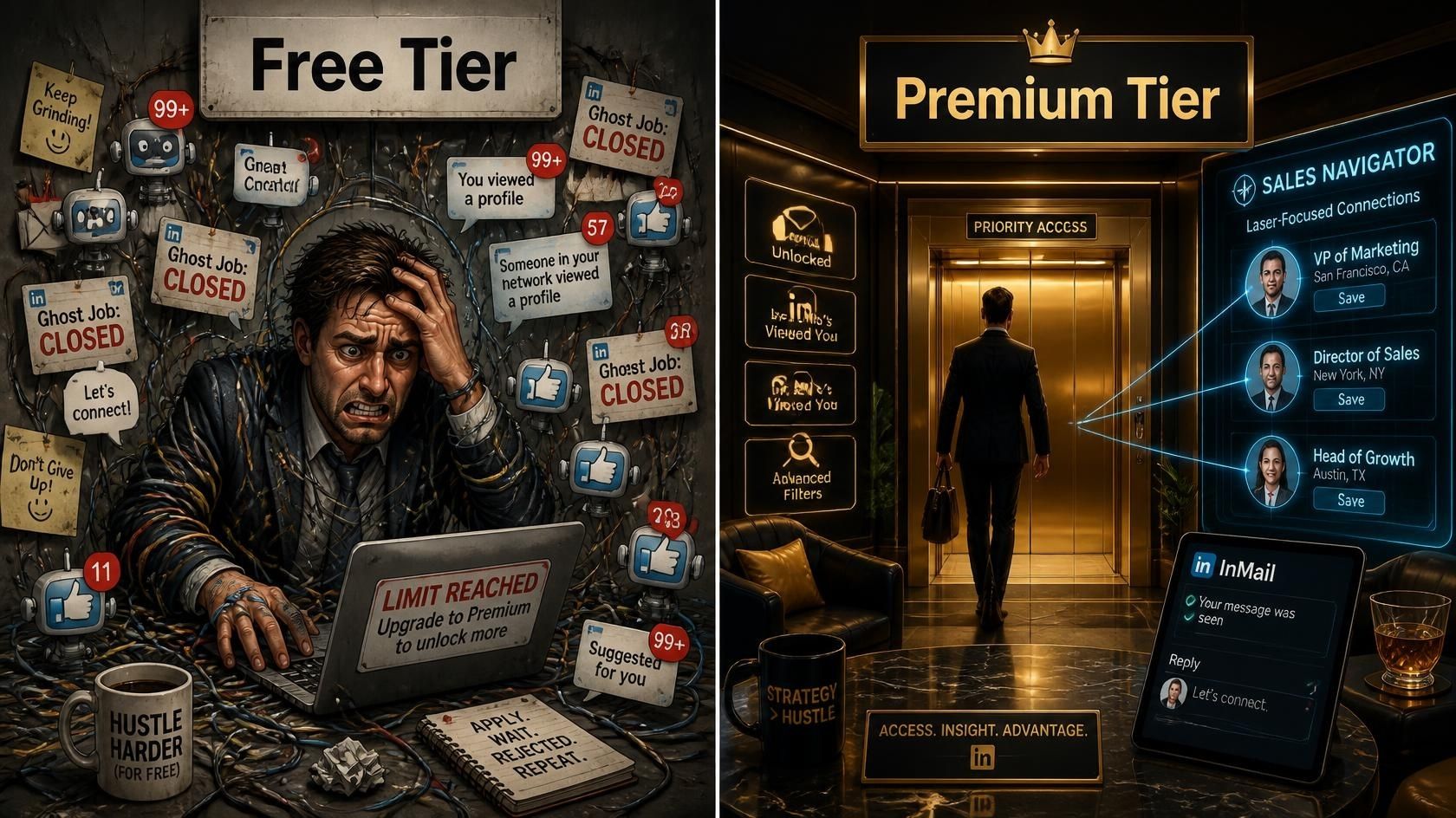
The Premium Paywall
Paying $40/month just to see who viewed your profile, sending cold InMails into a black hole of ghosting.
The Death of Authenticity (Sociological Dimension)
Corporate Newspeak
LinkedIn has created a unique dialect of hyper-polite corporate euphemisms:
- “Open to Work” = “Desperately navigating an unpredictable labor market.”
- “Unpacking synergy” = “I spent 4 hours in a meeting that could have been a 2-line email.”
- “Honored to be named Top Voice” = “I posted 5 times a day until the algorithm gave up.”
The “Toxic Positivity” Shield
Why genuine critique or dissent is strictly taboo. On X/Twitter, people fight. On LinkedIn, everyone is “thrilled”, “humbled”, and “excited to share”.
The Tech Dimension – Generative AI & The Highly Automated Echo Chamber
AI-Generated Synergy
The emergence of “Rewrite with AI” buttons turning mediocre thoughts into generic corporate gooblydook.
The Bot-to-Bot Economy
AI writing posts for AI bots to leave comments (“Great insights, thanks for sharing!”), creating an ecosystem where humans are completely optional.
The PR Machine & Perception Management
Beyond individual ego, LinkedIn has evolved into an institutional perception management platform for corporations. Nowhere is this more obvious than in the modern hiring pipeline.
The “Ghost Job” Illusion
Consider the phenomenon of the “Ghost Job.” Companies, recruitment firms, head-hunters and individual agents, post vacancies with zero intent to hire.
- The Playbook: Post a “Head of AI Strategy” role to signal growth to investors, soothe overworked current employees, or benchmark industry pay scales.
- The Reality: The “No longer accepting applications” tag appears 48 hours later, not because they found someone, but because the PR objective was achieved.
Market research reveals that anywhere between 18% and 27% of all active job listings on LinkedIn are fake—positions with zero immediate intent to hire. In fact, nearly 40% of companies admit to posting phantom listings.
Posting a fictitious or dated job posting is perhaps the quickest way of creating and enhancing a database of prospective candidates. A database that gets so overwhelmed, that the right candidates don’t surface to satisfy hiring mandates, and they end up posting the job opening yet again.
Over and above that if what we hear is to be believed, that a vast majority of job openings never find their way to hiring platforms, then isn’t this so redundant, insofar as the hiring process goes?
We now have AI right? How difficult is it to penalize these ghost listings?
The Corporate Perception Funnel
Why? Because posting an active opening for a “Vice President of Generative AI Strategy” costs relatively little, yet it accomplishes critical PR objectives:
- To Investors: It signals aggressive corporate expansion and fiscal health.
- To Overworked Employees: It creates the illusion that “help is on the way.”
- To Competitors: It projects dominance in emerging tech sectors.
When a job post mysteriously flips to “No longer accepting applications” 48 hours (or less) after launching, it rarely means a stellar candidate was sourced, interviewed, and onboarded in two days. It means the listing achieved its underlying PR target and was quietly deleted or archived.
Executive Image Laundering
Then is the rise of ghostwritten posts for C-suite executives. The corporate leader who “just had a deeply inspiring conversation with a barista” didn’t write the post—a 23-year-old PR intern drafted it to boost employer branding. And not to mention, replacement of authentic employee voice.
The Pitch Economy (Everyone is Selling Something)
LinkedIn is perhaps the only digital room on earth where 100% of the occupants are actively trying to sell something to the other 100%, while everyone maintains a tacit agreement to pretend otherwise.
The feed is no longer a conversation, it is a transactional queue:
The B2B Representative
Operating automated 5-stage cold outreach tools, sending personalized InMails: “Noticed we both share a passion for operational efficiency…”
The Solopreneur / “Thought Leader”
Weaponizing long-form text posts that always end with a carrot: “I curated a database of 400 prompts for cold calling. Comment ‘SYNCHRONIZE’ and my automated bot will DM you the PDF.”
The Career Coach
Monetizing tech-sector layoff anxieties by selling $1,200 “LinkedIn Branding Bootcamps” to professionals desperate to optimize their profiles.
This transactional density has driven Microsoft’s monetization of the platform to extraordinary levels. In fiscal year 2025, LinkedIn generated $17.81 billion in revenue—driven largely by its talent, marketing, and sales solutions.
The “InMail” Pitch Hierarchy
- Level 1 (The Solopreneur): Selling a $49 PDF guide on “How I Reached 100k Followers.”
- Level 2 (The B2B SaaS Rep): Sending automated 4-step cold-outreach cadences (“Noticed we both went to the university of life…”).
- Level 3 (The Career Coach): Monetizing layoff panic by selling $1,500 “resume optimization” bootcamps.
The “Value-Add” Trojan Horse
How long-form posts always end with a hidden sales pitch (“I compiled a spreadsheet of 500 AI tools. Comment ‘SYNCHRONIZE’ and I’ll DM it to you”).
“LinkedIn is the only digital room on earth where 100% of the occupants are attempting to sell something to the other 100%, and everyone is pretending not to notice. The candidate sells their docility; the executive sells their culture; the thought leader sells their PDF; and Microsoft sells the subscription that allows them all to message each other in the dark.”
The Monetization Engine – Pay-to-Play, The Tiered Feudal system
LinkedIn now monetizes the professional class by siloing key infrastructure behind monthly micro-transactions.
Premium Career/Business ($40–$70/mo): Pay to see who viewed your profile and bypass basic search limits.
Sales Navigator ($100+/mo): Turns human profiles into hyper-filtered “Leads” with custom Boolean searches and CRM integrations.
Recruiter Corporate ($800+/mo): Grants total visibility into user databases, allowing headhunters to bypass 3rd-degree network blocks.
Algorithm-as-a-Service
Pay-per-click sponsored posts cluttering the feed, ensuring that organic corporate news is suppressed unless paid for as an ad unit.
- Free Tier Basic visibility; capped searches; algorithmic noise.
- Premium ($40-70/mo): See who viewed your profile; basic cold InMails.
- Sales Nav ($100+/mo): Hyper-filtered lead tracking; CRM synchronization.
- Recruiter ($800+/mo): Unfettered database access; direct access to talent.
The result is a strict digital class structure. If you do not pay for Premium, Sales Navigator, or Recruiter Corporate, you are not a peer in the ecosystem; you are simply the raw data being indexed, filtered, and sold to those who do.
And then there are the ads. You’re now paying for “premium”, and yet, you’re bombarded with advertisements and paid promotions, most of which you don’t want, don’t need or aren’t even remotely interested in.
For crying out loud, I’m paying the platform. The very least you can do for me is give me an “ad-free” experience, or the tools to weed out unwanted, in-my-face content.
The there is the networking. Great Stuff! But, just because I’ve connected with someone, does it mean that I automatically want to follow them? Perhaps the connection I want in tactical, transactional or topical? I’m a professional. I know what I want. Whom I want to connect with. At the very least respect my professional boundaries and don’t set up a “follow-by-defaullt” algo! LinkedIn, now that you’ve done the follow-by-default bit, I need to take that extra step and go and unfollow people, I have no intent following.
Generative AI & The Automated Echo Chamber
If LinkedIn was already drowning in corporate euphemisms, the integration of generative AI has accelerated its slide into pure absurdity.
With platform-native “Rewrite with AI” buttons, human thoughts are routinely run through corporate smoothing filters. A simple observation like “We had a bad quarter because our pricing was wrong” is transformed into:
“Reflecting on our Q3 trajectory, we embraced a powerful opportunity to recalibrate our value-proposition architecture and align with market dynamics.”
We are fast approaching a near-complete bot-to-bot engagement ecosystem:
- An AI agent ghostwrites a post for a CEO.
- AI agents belonging to mid-level managers automatically detect the post and leave comments: “Incredible insights, thanks for sharing!”
- An AI summarizer condenses the comment thread for a reader who didn’t read the original post either.
In this setup, actual human cognition becomes entirely optional.
The Structured Verdict – Social Media or Digital Feudalism?
So, is LinkedIn a Social Media Platform?
- Functionally: Yes. It relies on algorithmic outrage, vanity metrics, attention economics, ad placement and engagement framing.
- Culturally: It is something far more insidious. It is social media disguised as productivity—a digital corporate hallway where everyone is wearing an invisible lanyard, trying to sell each other SaaS products they don’t need.
LinkedIn is social media disguised as duty. It is a digital corporate hallway where everyone is forced to wear an invisible company lanyard, nod approvingly at mediocre platitudes, and pretend that corporate survival is equivalent to self-actualization.
Mainstream social media platforms at least possess the honesty of being entertainment. You go to Instagram to look at vacation photos; you go to YouTube to watch tutorials.
We mock it, we screenshot its most unhinged posts for group chats, and we complain about the toxic positivity.
Yet, because our livelihoods, networks, and next mortgages are tied to our professional visibility, we quietly log back on, update our badges, and type: “Thrilled to announce…” to make sure our digital avatar looks successful enough to survive the next round of restructuring.
The 2016 Shift – Microsoft Takes Over, An Analysis
On June 13, 2016, Microsoft announced its agreement to acquire LinkedIn for $26.2 billion in cash ($196 per share)—making it the largest acquisition in Microsoft’s history at the time. The deal officially closed on December 8, 2016.
Prior to 2016, LinkedIn operated primarily as an online résumé repository and job board. The acquisition by Microsoft under CEO Satya Nadella fundamentally altered the platform’s economics, architecture, and cultural function.
The Strategic Motivation – Bridging Productivity and Social Identity
At the time of the deal, LinkedIn was struggling with monetization and user retention. Members would log on only when actively searching for a job. For Microsoft, acquiring LinkedIn was not about building a conventional “social network” to compete with Facebook; it was about securing the graph of professional identity.
Microsoft sought to link LinkedIn’s network of 433 million users with its enterprise product ecosystem (Office 365, Outlook, Azure, and Dynamics 365). The goal was to ensure that whenever someone wrote a resume in Word, sent an email in Outlook, or closed a sales deal in Dynamics, LinkedIn’s underlying data layer powered the interaction.
Structural Shifts Post-Acquisition (2016–Present)
Monetization & Paywalls
Microsoft shifted LinkedIn toward high-margin B2B SaaS revenue models. Features that were previously free (such as advanced network searches, viewing full profiles, or direct messaging) were restricted behind tiered subscriptions like Sales Navigator ($100+/mo) and Recruiter Corporate ($800+/mo).
The Creator Economy & Feed Redesign
To keep users logging in daily, rather than just during career transitions, Microsoft transformed the main feed into an algorithmic content stream. They incentivized posting via creator programs, “Top Voice” badges, and engagement metrics, which inadvertently fueled the rise of performative personal branding and corporate storytelling.
Up-skilling Infrastructure
In 2015, just prior to the buyout, LinkedIn acquired Lynda.com for $1.5 billion. Under Microsoft, this was fully rebranded and deeply integrated as LinkedIn Learning, monetizing professional upskilling anxiety and linking course certifications directly to profile badges.
AI & Azure Infrastructure Migration
LinkedIn’s backend was migrated to Microsoft Azure. In recent years, Microsoft’s partnership with OpenAI led to platform-wide AI integrations, including AI-assisted post writing, automated candidate screening for recruiters, and algorithmic messaging tools.
The Net Result
The 2016 takeover successfully scaled LinkedIn’s business model, growing its revenue from approximately $3 billion around the time of the acquisition to over $17 billion annually.
However, this commercial success altered the platform’s character. By weaponizing algorithmic engagement and deep monetization across recruitment, sales, and personal branding, the takeover completed LinkedIn’s transition from a utility-focused job board into a high-stakes, pay-to-play corporate panopticon.
For a deeper look into the strategic rationale and corporate change management behind Microsoft’s acquisition, this breakdown explores Leadership Lessons from Microsoft Acquiring LinkedIn. It offers valuable context on how Microsoft integrated LinkedIn’s enterprise capabilities while scaling its ecosystem.
FAQ: The Mechanics of Modern LinkedIn
Q: How did Microsoft’s acquisition in 2016 alter LinkedIn’s business model?
A: Prior to 2016, LinkedIn functioned primarily as an asynchronous online resume repository and job board. Following Microsoft’s $26.2 billion acquisition, the platform was restructured into an enterprise B2B SaaS ecosystem. Microsoft integrated LinkedIn’s professional graph into Dynamics, Outlook, and Azure, while siloing key network features behind high-margin monthly tiers like Sales Navigator and Recruiter Corporate, transforming organic networking into pay-to-play infrastructure.
Q: Why has LinkedIn content shifted toward personal stories and performative posturing?
A: To increase daily active user (DAU) retention, LinkedIn overhauled its feed algorithm to favor creator engagement, personal storytelling, and “thought leadership”. Because only ~3% of users post weekly, the algorithm heavily rewards posts that evoke high-emotion reactions—giving rise to the “humblebrag” format, performative vulnerability, and corporate newspeak.
Q: How is Generative AI affecting the quality of content on LinkedIn?
A: Platform-native AI integration (“Rewrite with AI”) has automated corporate jargon, creating a closed-loop bot-to-bot engagement system. Generative AI models ghostwrite posts for executives, while automated mid-level management profiles drop AI-generated comments (“Great insights!”), removing the necessity for human cognition or authentic discourse.
Q: Why do companies post “Ghost Jobs” on LinkedIn?
A: “Ghost Jobs” are active listings posted with zero immediate intent to hire. Companies deploy them as perception management tools: to signal growth to stock markets, soothe overworked staff by pretending help is on the way, and benchmark salary ranges against competitors without committing payroll.
About the Author
Sumir Nagar is an author, board advisor, and global executive. Over three decades across four continents, he has held senior leadership roles at leading international and regional financial institutions, and growth-stage fintechs. He serves as a Certified Independent Director and Nominee Director with a leading Development Financial Institution. He is the author of The Fire Beneath Stillness and writes on leadership, technology, governance, and human behavior at sumirnagar.com and The Confluence Review.
Leave a Reply