
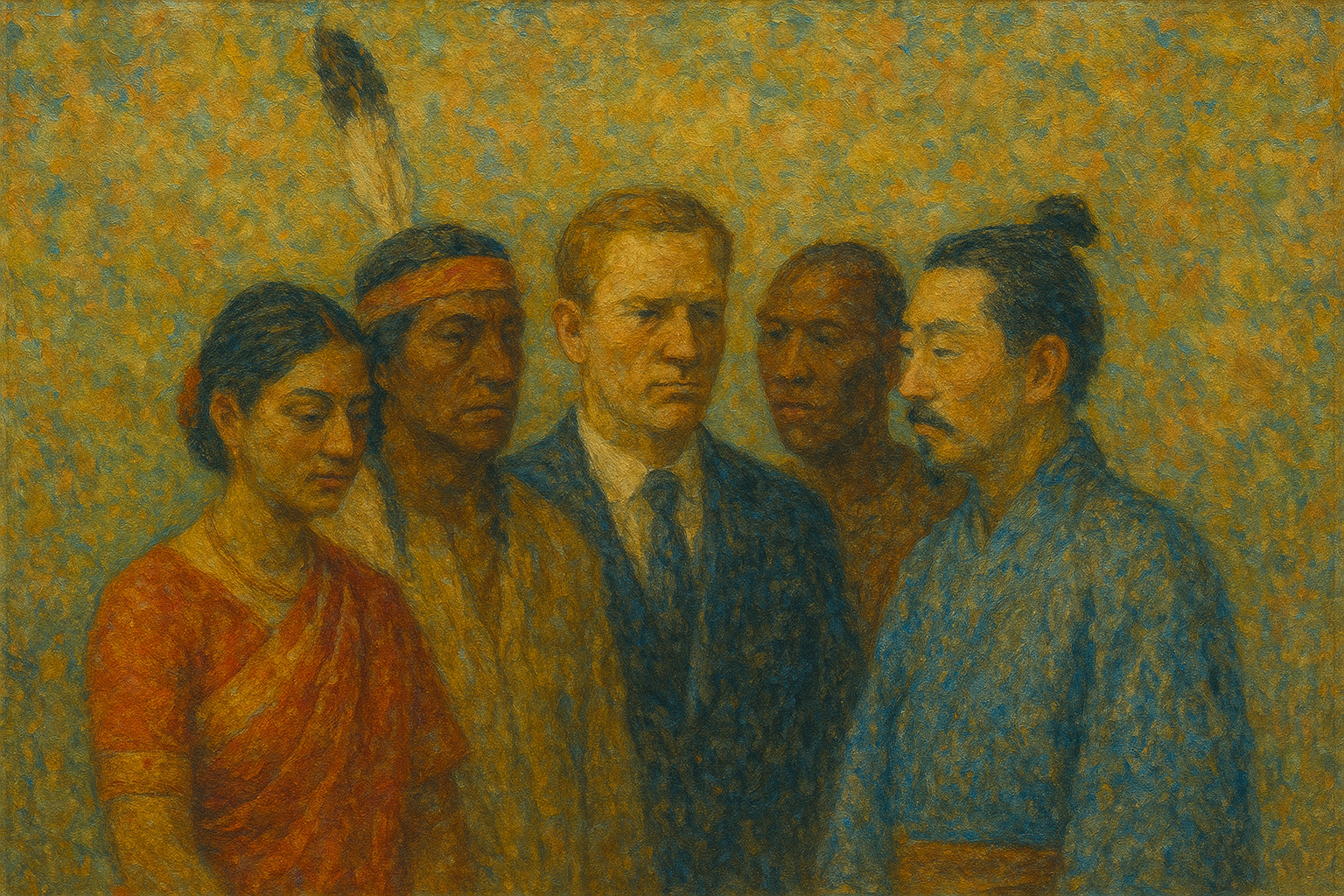

By Sumir Nagar
Foreword
We teach calculus in schools, train workers to run billion-dollar systems, and send astronauts to space. But ask someone how racial bias operates, and you’ll get blank stares. Inquire about how to deeply respect a culture not their own, and you might witness fragile outrage.
Over the years, we’ve been schooled in different quotients:
- IQ — your logic and problem-solving horsepower.
- EQ — your emotional self-awareness and empathy.
- SQ — your spiritual grounding and inner compass.
When Did Intelligence Leave the Room?
But there’s one more quotient that society never taught — RQ: Racial Intelligence. The ability to decode identity, history, power, perception, and culture — without fragility, denial, or defensiveness.
Why? Because we’ve mistaken education for enlightenment. And confused tolerance with understanding.
This isn’t about you. But it also is. Most conversations on race either coddle the fragile or vilify the ignorant. Neither heals. Neither helps.
I’m not guilt-tripping you. I’m giving you truth upgrades.
What the world is starving for isn’t more noise, more apologies, or better optics. There is far too much of that going around.
We’re starving for a new kind of intelligence. This would be a moral operating system. It should decode history, correct perception, and re-calibrate human worth. That system is called Racial Intelligence.
You Were Born Into a Rigged Game — Now What?
We are all shaped by invisible architecture — of race, gender, borders, intelligence, class, caste, and culture. But very few ever pause to see it. In fact we hide behind what’s convenient. Fewer still ever question it. And almost none are trained or for that matter willing to dismantle it.
This is where Racial Intelligence becomes not just necessary — but revolutionary.
Because this isn’t just about race. It’s about how race intersects with everything we pretend is separate — Gender. Geography. Class. Intellect. Language. Appearance. Let’s not forget your zip code!
Let’s break open the structure — from roots to roof. This isn’t woke theatre. This is a survival skill — For humanity. For leadership. For the soul.
Because if your brilliance doesn’t include basic empathy, You’re not intelligent. You’re just well-programmed.
Why I Wrote This
Sure, my articles win me applause and raise eyebrows in equal measure. But, I wrote it because too many conversations about race are too safe to matter. Other discussions are too shallow to transform.
I’ve lived and worked across four continents. I’ve seen talk about equity in boardrooms and bars alike. At the same time, they outsource exploitation. I’ve seen cultures celebrated in marketing decks but erased in strategy meetings. I’ve watched smart people stay silent, and privileged people weaponize ignorance.
This article isn’t an academic exercise — it’s a mirror, a map, and a megaphone.
Because Racial Intelligence isn’t just about color. It’s about power, perception, geography, skill, class, and history. We must learn to see the entire architecture. Otherwise, we’ll keep fixing the cracks while the foundation rots.
I wrote this because I’m done pretending we don’t know better. Now it’s about doing better.
About the Author
Sumir Nagar is a corporate strategist, philosopher, and seeker who believes real intelligence begins where bias ends. He has over 30 years of experience across four continents. He speaks the language of systems. However, he listens to the language of souls. Find him at www.sumirnagar.com or on Instagram @SumirTheSeeker. He has recently published his first book, The Fire Beneath Stillness. It is currently available on digital platforms. The print version will be released soon.
What is Racial Intelligence (RQ)? – Not Just Woke, But Wise
Racial Intelligence (RQ) involves the conscious and consistent understanding of race, power, identity, and systemic bias. It is a culturally competent approach embedded in how we think and lead. It affects how we relate, hire, heal, and build.
Racial Intelligence is the capacity to:
- Recognize and understand racial dynamics — historically, psychologically, and culturally.
- Reflect on your own implicit biases and inherited perceptions.
- Respond to racial situations with empathy, maturity, and contextual sensitivity.
- Reject performative alignments in favor of authentic solidarity.
It’s composed of three interwoven dimensions:
- Cognitive Awareness – Understanding historical oppression, cultural nuance, and modern systemic inequality.
- Emotional Fluency – Managing the discomfort, guilt, and resistance that arise when privilege is challenged.
- Ethical Application – Acting with informed integrity — not performatively, but progressively.
It’s not just emotional intelligence with melanin. It’s the interdisciplinary wisdom of history, psychology, sociology, and humility.
The Intersections – Racial Intelligence Isn’t a Solo Act
When people hear “race,” they often think color. But Racial Intelligence isn’t about melanin — it’s about power. And power is always compounded or challenged by other identities. Let’s decode them:
1. Race × Gender: The Double Bind
Patriarchy doesn’t operate in isolation — it adapts to racial and cultural context. Black women, Dalit women, Indigenous women face layered marginalization.
Example:
- Serena Williams – A Black woman scrutinized for her body, her voice, her strength. What’s praised in white male athletes is pathologized in her.
- Mahsa Amini (Iran) – Her death for allegedly violating hijab laws sparked global protests. Gender oppression meets ethnic identity (she was Kurdish).
To uplift racial justice, you must address gendered racism, not just racism alone.
2. Race × Intelligence: The Bias of “Brains”
Western constructs of IQ, genius, and education are coded in colonial lenses. Intelligence is racialized — often unconsciously.
Example:
- Harvard Admissions Case (2023): Asian-Americans scored higher but were penalized on “personality” to balance diversity.
- Dalit Scholars in Indian Academia face academic apartheid — denied mentorship, accused of quota unworthiness.
- Global South Scientists often under-credited in collaborations with Global North institutions.
If your measure of intelligence excludes cultural context and linguistic diversity, you’re not measuring intellect — you’re measuring assimilation.
3. Race × Urban vs Rural: Geography is Privilege
Where you live often determines if you live — and how you’re treated when you do.
Examples:
- Flint Water Crisis (USA): Predominantly Black and poor community denied clean water. This is an urban infrastructure failure. It is rooted in racial disregard.
- India’s COVID Oxygen Crisis (2021): Urban elites escaped to private hospitals; rural Dalits died without access.
- Africa’s Urbanization – Slums are expanding rapidly. Colonial extraction cities like Nairobi and Lagos are bursting at the seams. There is no structural equity present.
Racial intelligence must include a lens of locational injustice — poverty looks different in postcode 90210 vs pincode 246121.
4. Race × East vs West: Whose Truth is Truth?
Global media frames are coded in Western morality, often painting non-Western resistance as primitive or threatening.
This manipulation of narrative and perception is explored further in an article on my blog. It is called The Truth Paradox – How Reality is Built, Distorted & Weaponized. In the article, I break down how ‘truth’ is curated and used as a tool of influence.
Examples:
- COVID Origins Narrative: Quick to blame “wet markets” in China. Slow to examine Western pharma greed. It is also slow to look into bioweapon labs or vaccine inequity.
- Hijab Protests in Iran vs India: Celebrated in the West when Iranians remove hijabs. It is condemned when Indian Muslim women fight to keep theirs.
If your racial intelligence doesn’t include a critique of geopolitical double standards, it’s still colonial empathy.
5. Race × North vs South: Economic Apartheid
The Global North holds economic, pharmaceutical, and narrative control — while the Global South suffers extractive consequences.
Examples:
- Global Climate Talks (COP): Global South countries contribute least to carbon emissions but pay the highest price. Reparations promised, rarely delivered.
- Vaccine Hoarding (2021): G7 nations secured doses for 4x their populations, while many African countries had under 5% vaccinated.
- IMF & World Bank policies have structurally disadvantaged Latin America, Sub-Saharan Africa, and parts of Asia. This disadvantage persisted long after colonizers left.
Racial intelligence must be globally aware — not just personally woke.
6. Race × Skill & Trade: The Hierarchy of Hands vs Minds
Bias doesn’t just exist between black and white or between east and west. It also exists between those who work with their hands and those who claim to think for a living.
Skill-based discrimination is one of the oldest but least discussed engines of systemic bias. And it almost always wears a racial, caste, or class mask.
This economic exploitation is framed as “opportunity.” It echoes themes from Privilege and Safety Nets. The themes are detailed in The Inherited Advantage We Rarely Talk About, an article on my blog. In it, I unpack how systems are built to protect some and exploit others.
Examples:
- The Indian Caste System codified skill-based segregation of society as a means of co-dependence. This system was later misused. Workers handling leather, cleaning, or labor tasks were marked “untouchable.” Meanwhile, priesthood and scholarship were glorified. I’ve done a deep dive into this in a series of articles on Social Stratification.
- Mexican and Central American laborers in the U.S. are foundational to agriculture and construction, yet vilified in immigration rhetoric.
- African artisans and tradespeople are often denied visas or devalued globally, despite generational expertise in craft, design, and metalwork.
- Filipino nurses, Sri Lankan housekeepers, and South Asian construction workers are economically essential across the Middle East. However, they are treated as expendable or invisible.
- Chinese factory workers built the modern West’s electronics empire — yet are scapegoated in global trade wars.
We claim to respect “hard work” — but only when it’s white-collar and linguistically polished.
Racial intelligence forces us to ask:
- Who benefits from this skill hierarchy?
- Who gets called “unskilled” even after 10,000 hours?
- Why do some trades invoke admiration, while others trigger suspicion?
The global economy runs on largely invisible brown, black, and immigrant hands. The only difference between dignity and disdain… is perception.
Until RQ includes how we racialize labor, we will keep confusing talent with status, and contribution with class.
7. Race × Economic Utility – The Hidden Cost of Global Capability Centers
I’ve been privy to a ringside view of this phenomenon and despite my roots fought my way to the top.
So let’s talk about what the corporate world never puts in the PowerPoint. There are racial, regional, and class biases. These biases are embedded in how and where value is created.
So-called Low-Cost Development Centers or Global Capability Centers (GCCs) are not “strategic hubs.” They are geo-coded by neo-colonial capitalism, and here’s how:
Examples:
- India, Philippines, and Eastern Europe became back offices to the West. This was not due to capability alone. It was because of currency arbitrage, lower costs, and cultural deference to the West.
- African nations are routinely excluded from the GCC game. This is not due to lack of talent. It is due to a biased assumption of instability and skill and mental inferiority.
- Brazil and Latin America were long viewed as “too political” for strategic offshoring — despite massive urban tech pools.
- GCCs in Vietnam, Bangladesh, and Indonesia are praised for “discipline.” They are also noted for “low attrition.” This is a corporate code for quiet obedience, cheap labor, and lack of alternate opportunities.
The GCC model isn’t global collaboration — it’s outsourced dependency. It depends on:
- Paying less for the same or better output.
- Inhuman work hours and work-life balance.
- Hiring from countries with fewer rights, weaker labor protections, and greater socioeconomic desperation.
- Structuring power so that strategy stays in the West while execution is delegated to the Rest. I was witness to this front and center. That said, we made significant efforts to move the local workforce up the value chain. However, it was systematically dismantled when decision-making power changed hands. It is a fact that an expat was parachuted to India, to achieve this.
A talented coder in India wants a seat at the Silicon Valley table. Yet, they’re told they’re “not senior enough.” They’re considered “not strategic.” They are also said to be “lacking global experience.”
If your headquarters still treats your GCCs as “cost centers” and not co-creators, you’re running a racialized business model.
GCCs are the modern equivalent of colonial plantations. The West extracts intellect, scales efficiency, and hoards profit. Meanwhile, the Global South remains stuck in the “execution zone.”
Racial Intelligence needs to include an audit of how we globalize power, ownership, and innovation. Without this, we’re just white-washing capitalism with the language of “diversity.”
The Cause
Before we tackle symptoms, we must dissect source code — where racial blindness begins.
The Deep Upstream Causes of Racial Illiteracy
- Colonial Conditioning – The world’s systems — borders, languages, economies — were shaped by colonial conquest. They remain so in several instances, even until this day. Power is color-coded. White supremacy isn’t a fringe belief — it is a global design. We still operate inside its scaffolding.
- Education That Edits – Curriculums glorify conquerors, erase resistance, and sanitize atrocity. If you learned history from winners, your worldview is incomplete — and complicit.
- Cultural Gate-keeping – Media still centers Eurocentric beauty, English as superiority, and fair skin as default. Everything else is “ethnic,” “exotic,” or “other.” This isn’t random — it’s conditioning.
- Religious Justification – Slavery, caste, and conquest were often sanctified through misinterpreted scripture, twisted by dogma. RQ demands we question not just laws, but the belief systems that built them.
- Invisibility of Privilege – Privilege is not what you have — it’s what you don’t have to think about. Racial intelligence begins when silence feels suspicious, not safe.
The Multi-Layered Downstream Impact of Low RQ
The lack of racial intelligence doesn’t just cause “hurt feelings.” It causes systemic failure across every layer of society.
- In Individuals
- Identity crisis for the marginalized.
- Fragile egos for the privileged.
- Emotional ineptitude in inter-racial engagement.
- Guilt without growth.
- Anger without direction.
- At Workplaces
- Tokenism and superficial diversity hires. Meet the numbers to look good.
- Micro-aggression masked as banter.
- Biased KPIs, unequal pay, glass ceilings.
- High attrition among marginalized staff, disguised as “forced attrition” using bell curves.
- Innovation suffocated by monoculture.
- In Institutions
- Education systems that don’t represent the students they serve.
- Health care systems that don’t trust or treat colored bodies equally.
- Law enforcement rooted in fear, not protection.
- Politics that weaponize race instead of uniting humanity.
- In Society
- Protests without policy reform.
- Social media outrage cycles with no legislative muscle.
- Inter-generational trauma perpetuated by silence.
- Segregation disguised as “choice”.Culture wars replacing cultural understanding.
The Interlinked Web – A Matrix of Margins
These aren’t isolated issues. They’re a web of power. Here’s how they reinforce each other:
| Factor | Upstream Root | Downstream Effect |
| Race | Colonial hierarchy, pseudoscience | Color, over-policing, media bias |
| Gender | Patriarchy + racialized misogyny | Gender pay gaps, honor killings, under-representation |
| Intellect | Eurocentric academia, linguistic supremacy | Credentialism, intellectual erasure, brain drain |
| Location | Urban elitism, zoning, neglect of rural investment | Infrastructure decay, health disparity, caste clusters |
| Geography | Colonial legacy, Western supremacy narratives | Aid politics, selective justice, cultural invalidation |
It’s not a pyramid. It’s a machine — and every gear reinforces the next.
The Hidden Emotional Costs – Silence, Guilt, and the Performance Trap
Many privileged people perform empathy while avoiding engagement. They share hashtags but won’t question inappropriate jokes over dinner and drinks. They hire “diverse talent” but never examine how culture gets flattened for assimilation.
Meanwhile, those from marginalized groups live on an emotional treadmill:
- Code-switching to survive
- Shrinking themselves in meetings
- Educating others at their own expense
- Absorbing the cost of everyone else’s learning curve
RQ is about stopping this cycle — not with pity, but with policy, practice, and personal courage.
The Resistance to RQ — And Why It’s So Loud
Why do people reject racial intelligence?
- It hurts the ego. Admitting privilege feels like a loss to those who never saw it as unearned.
- Because it exposes complicity – Many benefit from racist systems, quietly. RQ makes it hard to stay quiet.
- Because it forces inner work – RQ is not an intellectual pursuit. It’s an emotional detox. It requires sitting with discomfort — and most people prefer comfort over clarity.
But here’s the paradox: The discomfort is the doorway to growth.
Why We Need Racial Intelligence — Now More Than Ever
In a world gasping for justice and choking on denial, RQ isn’t a “nice-to-have.” It’s survival gear.
- Because History Wasn’t That Long Ago – Slavery, apartheid, colonialism, redlining, caste systems — we’re not talking ancient history. We’re talking grandparent memory. Denying its impact is like ignoring the blueprint of the building you live in.
- Because Racism Didn’t Vanish — It Just Rebranded – Modern racism is rarely a burning cross. It’s quieter. It’s in hiring patterns, neighborhood funding, airport stares, school textbooks, and algorithms. RQ helps you see what’s invisible to the comfortable.
- Because “I Don’t See Color” Is Intellectual Laziness – Color exists. Culture exists. RQ teaches us to appreciate difference without fetishizing or fearing it. The problem was never color — it was always contempt.
- Because Well-Meaning Doesn’t Mean Well-Equipped – Many say “I’m not racist,” but freeze in real-world situations. RQ arms you with context, language, and confidence — not to debate, but to engage meaningfully.
What Racial Intelligence Looks Like in Action
It’s not a certificate. It’s a mindset in motion. RQ isn’t about guilt. It’s about growth. It’s not shame. It’s shared humanity.
RQ in Real Life – What It Looks Like When It’s Working
- In Education – Teaching diverse histories, not just dominant narratives. Classrooms that decolonize minds as much as they sharpen them.
- Teaching African, Indigenous, Dalit, Adivasi, Asian, Latinx, and Arab histories not as footnotes — but as foundational chapters.
- Encouraging critical questioning of “official” narratives.
- Training teachers in trauma-informed, culturally responsive methods.
- In Leadership – Hiring beyond tokenism. Addressing pay gaps. Challenging boardroom bias. Workplaces where culture isn’t just “celebrated” once a year but designed into daily systems. Leaders who apologize and amend
- Saying “We have a diversity problem” is not brave. Fixing it is.
- Equity isn’t just who gets hired. It’s who gets heard. It’s who gets promoted. It’s who gets safe space to lead as they are.
- Creating psychological safety across racial lines is a leadership KPI.
- In Law and Justice – Legal systems where race doesn’t determine sentencing.
- Reforming training, not just procedures.
- De-funding doesn’t mean dismantling — it means reallocating toward non-racialized safety.
- Making racial bias a performance metric — with consequences.
- In Daily Life – Listening without defensiveness. Advocating without centering yourself.
- Noticing patterns in your friendships, circles, habits.
- Listening without interrupting or invalidating.
- Calling in, not just calling out.
- Shifting from savior to solidarity.
- In Policing – Moving from fear-based enforcement to relationship-based protection.
- Social structures where difference isn’t dangerous, but divine.
This isn’t utopia. It’s just a world where intelligence includes conscience.
The Real Work – Building Your RQ Muscle
Like fitness, this isn’t a one-day workshop. It’s practice, discomfort, and unlearning.
- Study, Don’t Scroll: Read Black, Indigenous, Dalit, migrant, and minority voices — not as an ally, but as a student.
- Notice Patterns: Who speaks in your meetings? Who gets interrupted? Who gets hired? Patterns reveal truths you didn’t design, but do uphold.
- Check Yourself: Defensive much? That’s the signal. Not to retreat — but to reflect.
- Don’t Outsource the Burden: Don’t ask “what can I do?” every time there’s injustice. Do the work. Read. Learn. Act. Privilege is not feeling the urgency until it affects you.
Beyond Wokeness – Toward Wisdom
“Woke” has become a buzzword — a performance. RQ is deeper than hashtags or outrage cycles.
It’s knowing that justice isn’t loud. Sometimes it’s in the quiet redesign of power. In who gets seen. Who gets heard. Who gets believed.
Racial Intelligence is not about fixing others. It’s about freeing yourself from inherited blindness.
What Racial Intelligence Really Demands
This is not a feel-good awakening. It’s a hard reboot.
- Policy Shift
- Equity-based budgeting — not “equal distribution,” but historical correction
- Racial audits in corporates, governments, policing
- Educational reform: inclusive histories, critical race pedagogy
- Media Reform
- Diverse newsrooms
- Bias disclosure in reporting
- Decentralized content creation from marginal communities
- Leadership Accountability
- CEO pay should reflect DEI impact, not just P&L
- HR scorecards must include lived experience, not just resume
- Religious and political leaders must unlearn caste, class, and color superiority
- Personal Reckoning
- De-center your discomfort
- Learn from the oppressed without expecting to be comforted
- Understand that silence is not neutral — it is compliance
Conclusion
We can draw several conclusions based on the context I’ve just set above.
The Real Revolution is Inner Work
Until we develop racial intelligence as a personal practice, we will keep repeating cycles of outrage. These cycles also include hashtags and inaction. This isn’t about being nice. It’s about being just. And justice, my friend, isn’t a trend. It’s a lifelong practice.
Racial Intelligence is the Final Frontier of Human Maturity
You may live your whole life untouched by war, disaster, or poverty. However, you will never live untouched by race.
The question is: Will you float in the comfort of ignorance? Or will you confront the architecture — and help redesign it? Because intelligence that cannot see injustice is just cleverness. And cleverness without conscience is how we got here.
If this truth stirs something in you, explore my quote collection. The Fire Beneath Stillness is a journey of awakening, resistance, and inner fire.
Call to Action – Stop Being a Spectator in a Rigged System
If you’ve read this far, congratulations — you’re aware.
But awareness without action is complicity dressed as intellect.
You now know how power hides in race, geography, gender, skill, and language.
You’ve seen how global capitalism smiles in public but exploits in private.
You’ve witnessed how silence isn’t neutral — it’s a vote for the status quo.
So here’s the ask:
- If you lead — audit your systems. Who benefits? Who’s missing? Who’s invisible?
- If you teach — disrupt the syllabus. Stop telling one-sided stories.
- If you earn privilege — use it like a crowbar, not a pillow.
- If you speak — amplify those who’ve been spoken over for centuries.
You don’t need another panel, pledge, or PR campaign. You need courage. To challenge comfort. To interrupt bias. To rewire the operating system of your life.
Because Racial Intelligence isn’t woke.
It’s warrior work.
And history will ask — What did you do when you finally saw it clearly?
Read. Reflect. Rage. Rebuild.
My work isn’t mere content — it’s confrontation. It’s the result when truth meets craft. It happens when systems are dissected with surgical precision. It occurs when silence is no longer an option. If something inside you stirred while reading this, good. That’s your signal.
This isn’t the end. It’s your ignition.
- Read essays that rip through illusion.
- Sit with the quotes that don’t let you look away.Share the truths that most are too afraid to say.
- Take what’s real — and make it louder, braver, and beautifully inconvenient.
Sumir Nagar writes for those who are done with polite lies and ready for sharp truths.
If that’s you — subscribe, follow, and join the rebellion of the awakened.
Instagram: @sumirtheseeker
eBook:The Fire Beneath Stillness
Leave a Reply