Ganesha – Lord of Intellect: Origins, Symbolism, Festival, Eternal Role.

Foreword

Lord Ganesha is the beloved elephant-headed deity. He is invoked as the remover of obstacles. He is also the guardian of beginnings and the master of intellect. While most know Him as the playful god of sweets and festivals, His origins are profound. His form is symbolic. His role in documenting sacred knowledge is unparalleled. To truly understand Ganesha, we must explore not just His birth stories. We should also look at how His worship has evolved. It ranges from ancient scriptures to today’s grand festivals.

About the Author

Sumir Nagar is a published author, corporate advisor, writer, and podcaster. He is also a seeker. He blends over 30 years of global leadership experience with a deep interest in philosophy, spirituality and cultural wisdom. He is the author of The Fire Beneath Stillness. He writes and speaks on themes of resilience. He discusses transformation and timeless truths that guide modern living. His work aims to connect the sacred with the practical. He helps individuals and organizations find clarity. They find purpose and strength in the midst of change.

The Many Origin Stories of Lord Ganesha

The Turmeric Child

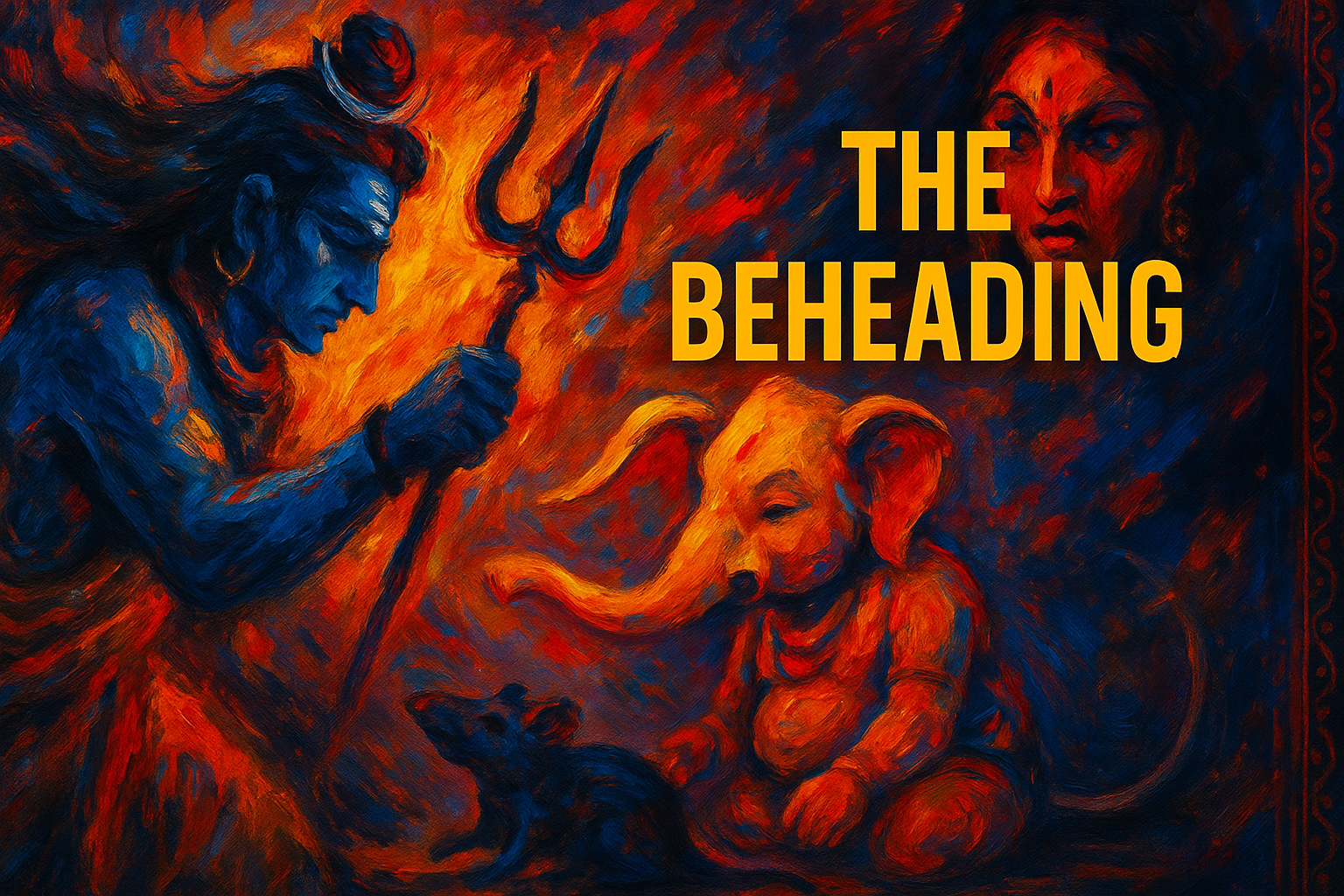
The story that is the most popular appears in the Shiva Purana, 2.4.13-35. Lord Shiva was away for a prolonged period of time. Shiva’s wife Parvati, desired to take a bath. She wanted someone to guard against intruders or prying eyes. Therefore, she created Ganesha from turmeric paste used for her bath. She then breathed life into him, and set him to guard her chambers.

Shiva, oblivious of this development, tried to enter. Ganesha blocked him. Enraged, Shiva severed his head. Parvati’s wrath and grief forced Shiva to restore him — this time with the head of an elephant. Thus, Ganesha was reborn and appointed remover of obstacles.

The Head of Gajasura

Another story appears in the Brahma Vaiivarta Ppurana, Ganapatii Khanda 15. After Shiva slew the elephant-demon Gajasura, He placed his head on Parvati’s son, thus giving rise to Ganesha.

Born of Shiva & Parvati

In the Padma Purana, Uttara Khanda 6.268-272, the story is that Ganesha is not created but directly born from their union. He is a child of divine power. The gods instantly acknowledge Him as the leader of beginnings. Therefore, Ganesha is invoked before the undertaking of anything new.

From Shiva’s Laughter

In this version, appearing in the Skanda Purana 1.3.2. 4-8, Ganesha emerges from Shiva’s laughter, radiant and powerful, and is appointed commander of His ganas (troops).

The Cosmic Principle

Ganesha is eternal, not “born” but a manifestation of Para Brahman — the universal spirit. He represents the principle of wisdom itself. This is stated in the Mudgala Purana 1.1.

The Curse of Shani

In the Brahma Vaivarta Purana, Ganapati Khanda 13.20-40, it is disclosed that Shani’s destructive glance burned Ganesha’s head, later restored with that of an elephant by Vishnu.

The Symbolic Form of Ganesha

Every single facet of Lord Ganesha is deep symbolism. His appearance signifies Lord Ganesha’s messages. His choice of ride conveys another message. His broken tusk and His belly each have symbolic meanings.

  • Elephant Head: Wisdom and foresight.
  • Big Ears, Small Mouth: Listen deeply, speak less.
  • Broken Tusk: Sacrifice for knowledge (Mahabharata, Adi Parva 1.70–80).
  • Pot Belly: Digesting life’s dualities.
  • Mouse Vehicle: Desire and ego mastered.

Ganesha as the Lord of Intellect

Ganesha embodies both Buddhi (intellect) and Siddhi (spiritual insight). His blessings are invoked not only to remove obstacles but also to sharpen our clarity of thought. Unlike Saraswati (pure knowledge), Ganesha represents applied knowledge — intellect in action. Read a related article: https://sumirnagar.com/2025/02/11/the-truth-paradox-how-reality-is-built-distorted-weaponized/

Ganesha – Scribe of the Mahabharata

Vyasa, the compiler of the vast Vedas chose Ganesha as His scribe for the Mahabharata. Our scriptures are vast and deeply meaningful. They comprise the entirety of our Vedas (Sacred revelations (eternal knowledge, hymns), Puranas (Mythic histories (stories of gods, cosmology), Upanishads (Philosophical insights (spiritual dialogues, metaphysics) and Itihasas (Epic narratives (Mahabharata & Ramayana, history-as-teaching).

The Mahabharat war was waged approximately five thousand years ago. It signified the advent of the Age of Kali, or Kaliyuga. With the advent of Kaliyuga, lifespans shortened. Distractions due to the Age of Kali increased. There was a fear amongst our seers that this vast body of knowledge would be lost forever. The Guru – Shishya (Teacher – Student) parampara (tradition) was on the verge of breakdown. Knowledge that was hitherto perpetuated verbally, via the disciplic succession in person, would be lost forever. Therefore Vyasa decided to take up the project of documenting the vedas.

This war of epic proportions, would bring forth profound teachings. Teachings that would serve humanity in the ages yet to pass. Vyasadeva needed someone with intellect to document the war, it’s genesis and teachings. Therefore Lord Ganesha was approached. He agreed to be the scribe on one condition: Vyasa must dictate without pause. Vyasa countered: Ganesha must write only after fully understanding each verse. Vyasa composed complex verses to buy time. Ganesha sacrificed his tusk when his stylus broke. This dynamic exchange gave humanity a treasure of wisdom. It was more than mere dictation. It was a cosmic collaboration between Vyasa, who organized knowledge, and Ganesha, who embodied it.

Ganesha & the Vedas

Ganapati is invoked as Brahmanaspati, the lord of prayer and sacred sound.

“We invoke thee, O Ganapati, the seer among seers, the greatest king, the lord of prayer, the lord of abundance.”

Rig Veda 2.23.1

The further identifies him with the very essence of sacred knowledge:

Verse 1: “You are verily the manifestation of Brahman.”
Verse 8: “You are the essence of the Rig, Yajur, Sama, and Atharva Vedas.”
Verse 12: “You are the eternal sound AUM.”

Ganesha Atharvashirsha Upanishad

Thus, Ganesha is not only invoked before rituals but is considered the living embodiment of the Vedas themselves.

Ganesha – Source of Power

I heard about this when I was in Vrindavana several years ago and it completely blew my mind. After I heard the story, I decided to do some digging.

What was the story that blew my mind? The story was that Lord Ganesha derives His power by placing Lord Nrsimha’s feet on His tumulii.

Lord Nrsimha is the fierce half man-half lion incarnation of Krishna. In certain tantric and Vaishnava traditions, Ganesha acknowledges Nrsimha as the source of His shakti. This is noted in Ganapati Atharvashirsha, Verse 16 – commentarial traditions.

Ganesha’s approachable, playful form hides a deeper truth. The source of His power. The connection is symbolic. Nrsimha annihilated Hiranyakashipu, the greatest obstacle to dharma (Nrsimha Purana 8). Ganesha removes the everyday and inner obstacles of seekers. Where Nrsimha is fierce, fiery, and unapproachable, Ganesha channels the same obstacle-destroying energy in a gentler, more accessible form.

This continuity shows a spiritual spectrum: Protection through Nrsimha, Preservation through Vyasa, and application through Ganesha.

Origins of the Ganesha Festival

I have never been a fan of loud, ostentatious, and crowded celebrations. I am against bringing religious festivities onto the streets. My way of worship is reflective, quiet and home based.

Therefore, this came up as a debate between my father and myself during my formative years.

He explained that, it was during the British Raj that the Ganesha festival became popular. At that time, Indians were prohibited from congregating in public. This was to prevent protests against British excesses. Therefore, those leading the freedom fight, decided to use the garb of a religious festival as an excuse to congregate.

That explanation did work for me at that time. However, in later years, I dug deeper. I discovered that the worship of Lord Ganesha in public pre-dated the freedom struggle.

Early Roots

  • Worship of Ganesha can be traced back to around the 4th–5th century CE (Gupta period).
  • Household rituals honoring him as Vighnaharta (remover of obstacles) predate the large-scale celebrations.

Rise of Ganesh Chaturthi

  • Peshwa Era (18th century, Maharashtra): The Peshwas, devout Ganesha worshippers, popularized Ganesh Chaturthi as a community festival.
  • Lokmanya Tilak (1893): During British rule, Bal Gangadhar Tilak transformed Ganesh Chaturthi into a public movement. Large pandals (community shrines) were set up to gather people across castes and classes, subtly resisting colonial suppression.

Ganesh Chaturthi thus became both a spiritual and socio-political movement — blending devotion with unity and nationalism.

The Festival Today: Noise vs. Wisdom

What began as a sacred festival of devotion has, in many places, devolved into a spectacle of excess. The streets overflow with blaring film songs, DJs, and unrelated music. These sounds drown out spiritual hymns, replacing quiet prayer and reflection. Noise pollution from deafening loudspeakers reaches dangerous decibel levels. \It is harmful not only to human health but also to animals, infants, and the elderly.

Lavish pandals funded by political parties and corporates turn worship into a show of power and wealth, sidelining devotion. Intoxication and unruly processions disrupt daily life. Traffic chaos creates additional problems.

Plaster-of-paris idols coated with toxic paints choke rivers and seas during immersion. This devastates aquatic ecosystems. Mountains of plastic waste, single-use decorations, and electricity-guzzling lighting displays add to the environmental toll.

We sought to honor the remover of obstacles. Instead, we’ve created new obstacles for health, harmony, and the planet itself.

Yet, Ganesh Chaturthi need not be a war on peace, nature, and sanity. It can return to what it was meant to be — a festival of reflection, unity, and devotion.

Imagine clay idols painted with natural colors, dissolving back into rivers without harm. Streets filled not with blaring film music but with devotional bhajans, classical instruments, and chants that uplift rather than assault. Processions are marked by discipline and reverence. They involve community participation, where children learn stories of Ganesha.

This is preferable to watching adults intoxicated in the name of celebration. Pandals powered by solar lighting, decorated with biodegradable materials, celebrating creativity without destroying the environment.

A festival where noise is replaced by prayer. Waste is replaced by sustainability. Intoxication is replaced by awareness. Spectacle is replaced by true spirituality. This is how honoring Ganesha truly removes obstacles. It brings balance, wisdom, and harmony back to both society and nature.

Conclusion: The Eternal Ganesha

Ganesha has many births across the Puranas. He also has a role as scribe of the Mahabharata. He figures in private household rituals and public nationalist festivals.

Ganesha has always been more than a god — He is a living philosophy. His symbolism teaches us to master desire, sharpen intellect, and balance humility with strength. His festival, even when commercialized, reminds us of community and unity.

To truly honor Him today, embody His message. Don’t just seek blessings; think, act, and live with clarity. Show compassion and wisdom in your actions.

Reference Appendix

Call to Action

If this exploration of Lord Ganesha inspired you, share it with someone. They might need a reminder of what true wisdom and clarity look like.

Read more reflections at www.sumirnagar.com

Follow me on Instagram @ notjustspirituality & LinkedIn Sumir Nagar for more insights on spirituality, resilience, and leadership.


Comments

Leave a Reply

This site uses Akismet to reduce spam. Learn how your comment data is processed.