
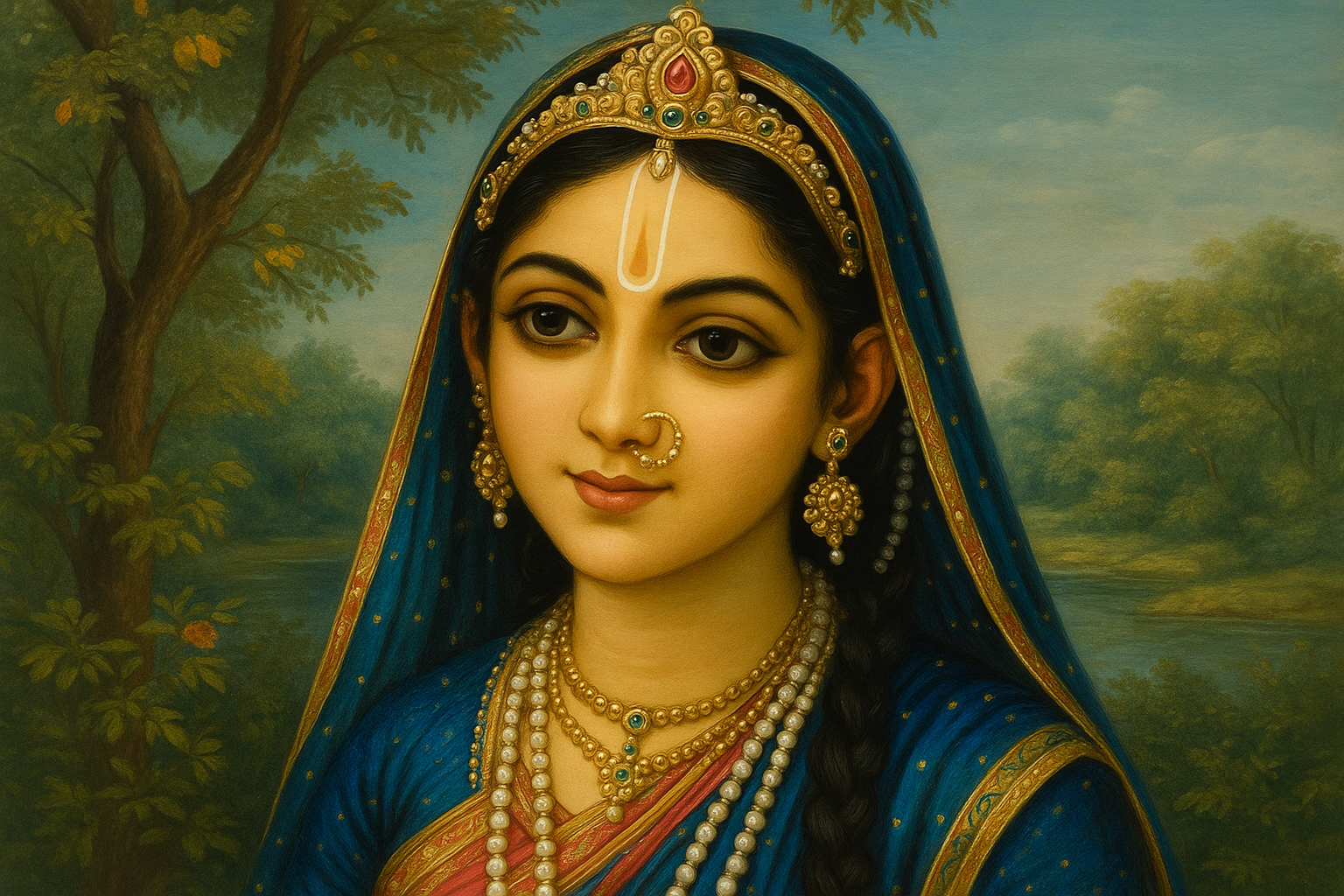

Foreword
We live in a world obsessed with noise—louder voices, bigger armies, flashier rituals, and stronger symbols of power. We celebrate force, not tenderness. We glorify the conqueror bearing weapons, not those who win us over with silent love. We bow to the warrior goddess Durga, the terrifying Kali, and the universal Devi.
However, on Radha Ashtami, the cosmos quietly nudges us to remember. Even God bows before love. If Janmashtami marks the birth of Krishna, Radha Ashtami explains why Krishna matters at all. Krishna without Radha is just a boy with a flute. Radha transforms his music into meaning.
- Radha Ashtami isn’t just another date circled on the Hindu calendar. It’s the cosmic reminder that without Radha, Krishna is incomplete. Without love, divinity is just a statue collecting dust.
- Radha didn’t slay demons, command armies, or thunder with rage. Radha didn’t wield weapons like Durga. She didn’t terrorize demons like Kali. She didn’t preside as a cosmic CEO like Devi. And yet, Radha conquered Krishna himself. Not through power, fear, or ritual—but through love and surrender.
And perhaps that is why her festival is less noisy: love rarely announces itself—it simply changes everything.
Radha Ashtami isn’t just about a goddess in Vrindavan. It’s about you, me, and the choices we make every day. We choose to lead with fear or to lead with devotion. We decide to fight with swords or to surrender with love.
About the Author
Sumir Nagar is an author, blogger, coach, and corporate executive. He has over three decades of experience across global organizations. His expertise spans banking, fintech, compliance, and startups. Having lived and worked on four continents, he blends a razor-sharp business mind with a deeply reflective, philosophical voice.
Through his blog (www.sumirnagar.com), his books such as The Fire Beneath Stillness, and his YouTube channel SumirTheSeeker, he explores themes of resilience, truth, spirituality, leadership, and personal transformation.
Known for his unique style—equal parts humor, satire, and philosophy—Sumir challenges conventional thinking. He invites readers to see life through sharper, braver lenses. His work ranges from corporate strategies to spiritual reflections, from motivational quotes to searing social commentary.
Greetings of Vrindavan – The Living Language of Devotion
In Vrindavan, devotion is not confined to rituals. It’s in the way people speak to each other. This is the land where Radha and Krishna’s love is believed to play eternally. Here, Radha Ashtami is not just a festival on the calendar but a way of life.
- Instead of saying a simple “Namaste,” locals greet each other with “Radhe Radhe.”
- Pilgrims walk the streets. Vendors sell sweets. Sadhus chant on the ghats. Everyone invokes her name as both a hello and a blessing.
- In Barsana, Radha’s birthplace, you’ll often hear “Jai Shri Radhe.” People also say “Radhe Radhe Shyam Milade” (“O Radha, unite us with Shyam”).
- Even temple bells seem to echo her name, and the entire town turns into a chorus of Radha’s remembrance.
This culture of greeting has deep symbolism: saying “Radhe Radhe” acknowledges that Radha is the doorway to Krishna. One does not reach God directly—you approach Him through devotion and belief. Just as in Vrindavan, you don’t simply arrive at Krishna’s temple; you first bow where Radha’s name is sung. On Radha Ashtami, the greetings become even more charged. Each “Radhe Radhe” is not just courtesy. It is a proclamation of love, surrender, and belonging to her eternal story.
Why Radha Matters
Radha – The Soul of Krishna
- Krishna without Radha is just another blue boy with a flute. His divinity becomes divine because of the love story Radha wrote into existence.
- Just as Shiva without Shakti is a corpse (Shava), Krishna without Radha is incomplete.
- Radha doesn’t merely appear in Krishna’s narrative—she defines it. She is not the supporting character. She is the heartbeat of the story.
- Radha is Krishna’s Hladini Shakti—the energy of bliss and devotion. The Brahma Vaivarta Purana says:
“Radha is Krishna’s very soul, his supreme Shakti. Without Radha, there is no Krishna.” (Krishna Janma Khanda 2.6)
This is not a romantic exaggeration but theological truth. Just as Shiva without Shakti is Shava (a corpse), Krishna without Radha is incomplete. Radha is not a supporting character in Krishna’s play. She is the play—the heartbeat of the divine drama.
Radha & the Cosmic Sisterhood
In India, a question naturally arises: is Radha the same as Devi, Kali, or Durga? Now, why does this question really arise? It arises because worship of Devi or the feminine energy is a fierce and powerful form is largely prevalent. However, Theologically, they are all manifestations of Shakti, the feminine divine energy.
Is Radha Devi? Durga? Kali? The answer is paradoxical—yes and no. She is not formally categorized in the same pantheon, but she is their essence.
- Devi (Mahadevi): The ultimate source, the universal feminine principle.
- Durga: The fierce protector of dharma.
- Kali: The terrifying yet liberating destroyer of illusion.
- Radha: The tender force of love that makes even God surrender.
“The Divine Mother is the source of all; from her the universe is born.” (Shvetashvatara Upanishad 4.3)
“Ya Devi sarva-bhuteshu shakti-rupena samsthita—O Goddess, you who dwell in all beings as energy, I bow to you.” (Devi Mahatmya 5.16)
“Kali is the primordial Shakti, dark as a thundercloud, who devours all.” (Kalika Purana 47.12)
Durga slays demons, Kali devours illusions, Devi sustains the cosmos—but Radha? She conquers Krishna himself.
The Brahma Vaivarta Purana goes further, describing Radha as the original Shakti, from whom even Durga, Lakshmi, and Saraswati arise. Radha doesn’t just belong to the pantheon—she is the fountainhead of its sweetest power.
“Radha is the origin of all goddesses. From her manifest Lakshmi, Saraswati, and Durga.” (Brahma Vaivarta Purana, Prakriti Khanda 4.80)
Radha in Poetry and Devotion
- Bhakti (devotion) literature elevates Radha above ritual and reason. Jayadeva’s Gita Govinda proclaims: “Krishna is controlled only by Radha’s love; without her, he does not find joy.” (Gita Govinda 10.12)
- Chaitanya Mahaprabhu echoed this truth: “Radha’s love is the highest form of devotion; she asks nothing, yet gives everything.” (Chaitanya Charitamrita, Adi 4.68)
- Radha embodies the idea that God is not conquered by rituals, mantras, or philosophy—He is conquered only by devotion.
Archetypes Within Us
Step out of Vrindavan for a moment. These goddesses are not just temple idols; they are psychological archetypes alive inside every human being.
- Radha (The Lover/Devotee): Your capacity to love without keeping score. Melts ego through tenderness.
- Devi (The Mother/Source): Your ability to nurture, sustain, and create wholeness. The ecosystem holder.
- Durga (The Warrior/Protector): Your fierce protector who draws boundaries and says, “enough.”
- Kali (The Transformer): Your inner destroyer who ends toxic patterns and forces rebirth.
Kali is described as the Mother who liberates by terrifying the ego; similarly, Radha liberates by dissolving it in love.
The Quadrant of Divine Energies
To make this practical, imagine your life as a quadrant of energies: A 2×2 framework can help us locate where we’re living:
- Radha (Love/Devotion): You’re fueled by passion, connection, giving. Shadow: Overgiving, self-neglect.
- Devi (Mother/Wholeness): You’re nurturing, stable, empathetic. Shadow: Over-responsibility, savior complex.
- Durga (Boundaries/Justice): You’re standing up for yourself, defending others. Shadow: Perpetual combativeness, tension.
- Kali (Endings/Transformation): You’re breaking illusions, starting new. Shadow: Destruction without renewal.
Balance is mastery. Mastery is not choosing one—it’s summoning the right goddess within you at the right time. Too much Radha, and you collapse. Too much Durga, and life becomes a battlefield. Too much Kali, and you burn bridges. Too much Devi, and you drown in duty.
Contemporary Relevance
- In Relationships: Radha reminds us love is not a transaction. Radha teaches us that the highest form of love is devotion without negotiation. Modern love keeps score—Radha erases the scoreboard.
- In Leadership: Durga’s fire may win respect and battles, but Radha’s tenderness wins loyalty. Great leaders don’t just command; they inspire devotion.
- In Spirituality: Modern “Instagram spirituality” is often performance and posturing. Radha cuts through the glitter: spirituality is not crystals and hashtags—it is love, presence, surrender. Radha cuts through Instagram spirituality’s crystals and hashtags—spirituality is not performance, but presence.
- In Inner Life: Krishna is divinity; Radha is your devotion. Without her, even your “God” remains theoretical. Ask yourself not what you conquered today, but what you loved today. That is your Radha check-in.
The Confusion – Where We Get It Wrong
We trivialize Radha as Krishna’s girlfriend, missing her status as the Supreme Goddess of Bhakti. We reduce Durga to “the demon slayer.” We reduce Kali to “the scary goddess.” In doing so, we strip them of their psychological and spiritual power. We don’t realise that they represent inner battles—slaying the ego (Mahishasura) or devouring illusion.
The truth is, Radha is not a side character in Krishna’s life. She is one of the reasons Krishna’s story matters. And Durga and Kali are not just about external battles—they’re about the wars you fight inside your own head.
Modern spirituality loves the dramatic forms (Kali, Durga) because they make good Instagram reels. Radha Ashtami challenges us. It unveils a quieter, more uncomfortable truth. The strongest energy in the cosmos isn’t destruction or protection. It’s devotion.
Radha Ashtami insists we face the quieter truth: devotion is the supreme force. As the Narada Bhakti Sutra explains, bhakti is higher than knowledge or rituals—and Radha embodies that truth absolutely.
The Deeper Takeaway
Radha Ashtami urges us to stop negotiating with God. For example, saying “If you give me a job, I’ll light 100 lamps” reflects a transactional mindset. Instead, we should step into selfless devotion. It’s about recognizing that the divine isn’t conquered by rituals or logic—it’s conquered by love.
Or, to put it bluntly: Radha Ashtami is the universe reminding you of a key lesson. The most powerful being in existence willingly surrendered. It wasn’t to war or wealth, but to love.
Radha Ashtami Through a Contemporary Lens
Modern times demand current explanations or parallels. To that end let’s also map this significance into a contemporary lens. So let’s examine what Radha Ashtami teaches us about relationships, leadership, or even modern spirituality.
Love > Power (Relationships)
In every relationship—romantic, familial, or even professional—there’s often a tug-of-war for control. Radha flips that game. She shows us that the highest form of power is not dominance, but surrender. Imagine bringing Radha’s principle into modern love. Instead of keeping score, you practice giving without expecting a return. That’s not weakness—that’s divine leverage.
Takeaway: The one who loves selflessly is the strongest, because they are free from the prison of expectation.
Radha as the Feminine Principle (Gender & Leadership)
Radha isn’t a side character in Krishna’s story; she is the story. In a world still obsessed with putting women in “supporting roles,” Radha Ashtami serves as a sharp reminder. Energy (Shakti) isn’t secondary—it’s central. In boardrooms, startups, or social movements, leadership without empathy and emotional intelligence (the “Radha energy”) is hollow and brittle.
Takeaway: True leadership is not about being the loudest in the room—it’s about being the heartbeat of the room.
Devotion > Ritual (Modern Spirituality)
Scroll through Instagram and you’ll find spirituality reduced to crystal collections, “high-vibe” hashtags, and $499 manifestation courses. Radha slices through all that nonsense: devotion is not about performance, it’s about presence. She teaches that what matters is not how much you show devotion but how deeply you feel it.
Takeaway: Replace performative spirituality with authentic connection—whether to God, to people, or to yourself.
Radha as a Leadership Archetype (Corporate Lens)
In organizations, we worship “Krishnas”—the star CEOs, the visionaries, the disruptors. But behind every Krishna is a Radha—someone (or a culture) that nurtures, loves, and sustains the vision selflessly. Without that devotion, the Krishna figure collapses.
Takeaway: Great leaders aren’t just built by strategy. They’re built by the quiet loyalty and love of those who believe in them. Celebrate your Radhas.
Radha & The Modern Human Condition
In an age obsessed with transactions—swipe rights, LinkedIn endorsements, KPI dashboards—Radha Ashtami tells us: not everything valuable can be measured. Her love defies logic, metrics, and ROI. And maybe that’s the point—life’s most meaningful currencies (love, trust, devotion) aren’t meant to be balanced on Excel sheets.
Takeaway: The immeasurable is often the most essential.
Radha Ashtami is not just about a goddess in Vrindavan—it’s a mirror. It prompts introspection. Where in your life are you being Krishna, expecting devotion? Where are you being Radha, giving it unconditionally? More importantly, are you wise enough to realize this? Without Radha, even Krishna is just another blue boy with a flute.
Radha and the Goddess Principle
Radha Rani is not formally slotted in the Devi–Durga–Kali pantheon in the way we classify goddesses. She belongs to the Vaishnava tradition as the eternal consort of Krishna and the embodiment of bhakti (devotion). But—and here’s the twist—philosophically, she is connected to Devi, Kali, and Durga. They are all manifestations of the Shakti principle.
Radha as Shakti (energy)
- Just as Parvati is Shakti to Shiva, Radha is Shakti to Krishna.
- Radha is called Hladini Shakti—the aspect of divine energy that represents bliss, love, and devotion.
- Without her, Krishna is incomplete, just as Shiva without Shakti is “Shava” (a corpse).
Connection to Devi / Durga / Kali
- Durga: Represents protective, warrior energy—the force that maintains dharma.
- Kali: Represents raw, transformative power—the destroyer of ego and illusion.
- Radha: Represents love and bliss—the energy that melts even God into surrender.
Think of them as different frequencies of the same cosmic energy. Durga is the fierce defender, Kali is the radical transformer, and Radha is the divine lover. Same Shakti, different costumes.
Theological Links
- In some traditions, Radha is considered a form of Mahadevi, the Supreme Goddess, just like Durga or Kali.
- The Brahma Vaivarta Purana explicitly describes Radha as the original Shakti, from whom Lakshmi, Durga, Saraswati, and others emanate.
- Vaishnavas thus see her not as separate, but as the fountainhead of feminine divinity.
Philosophical Contrast
If Durga/Kali represent fearsome power that brings surrender through awe, Radha represents tender power that brings surrender through love. Both lead to liberation—but one breaks your ego with a sword, the other dissolves it with a glance.
So, is Radha Rani Devi, Kali, or Durga?
Not directly. She isn’t worshipped in the same form or ritual context. But in essence, she’s their sister, their source, their reflection—depending on which tradition you ask. To the devotee, Radha is the sweetest form of Devi. She is not the goddess who slays demons. Rather, she is the goddess who conquers God Himself.
Radha vs. Devi vs. Durga vs. Kali Aspect
| Aspect | Radha Rani | Devi (Mahadevi) | Durga | Kali |
| Core Identity | Eternal consort of Krishna, Hladini Shakti (bliss & devotion) | The Supreme Goddess, source of all Shaktis | Warrior Mother, protector of dharma | Fierce destroyer, liberator, ego-crusher |
| Primary Domain | Love, devotion, bliss, surrender | Universal feminine energy, cosmic mother | Protection, justice, righteousness | Destruction of evil, time, illusion |
| Energy Type | Soft, tender, unifying | All-encompassing | Fierce, motherly, protective | Radical, fierce, transformative |
| Relationship to the Divine | Completes Krishna (God is not whole without her) | Embodiment of the ultimate feminine principle | Consort/energy of Shiva in some traditions | Form of Parvati/Shakti, inseparable from Shiva |
| Symbols | Lotus, flute (through Krishna), bridal adornment | Trident, lotus, lion, various forms | Lion/tiger, weapons, many arms | Garland of skulls, sword, dark form |
| Approach to Ego | Melts it with love & devotion | Transcends it through surrender to the cosmic mother | Fights and subdues it through discipline & dharma | Smashes it brutally, tearing away illusions |
| Spiritual Goal | Bhakti → union with God through love | Moksha → union with the Absolute | Dharma → protection of the righteous | Liberation → annihilation of ego & rebirth |
| Philosophical Link | Considered the original Shakti in Vaishnava texts (Brahma Vaivarta Purana) | Fountainhead of all feminine forms (Durga, Kali, Lakshmi, Saraswati, Radha) | A manifestation of Devi’s protective aspect | A manifestation of Devi’s transformative aspect |
Simplified Take
- Radha: The lover, the sweet power of devotion.
- Durga: The mother, the fierce protector.
- Kali: The liberator, the terrifying yet compassionate destroyer of ego.
- Devi (Mahadevi): The CEO—the all-in-one original energy field from which all others emanate.
To summarize, if Devi is the ocean, then Durga and Kali are the crashing waves. Radha is the gentle rain that makes you fall in love with life itself.
Radha, Devi, Durga, and Kali in the Modern Psychological Lens
Radha – The Lover / Devotee
- In Relationships: The part of you that loves without keeping score, that shows up just because your heart says so. Radha is your capacity for pure devotion—to a person, a cause, even your art.
- At Work: The colleague who fuels projects not with deadlines but with passion. Think of the team member who brings emotional glue and keeps the “soul” of the mission alive.
- In Inner Life: Radha is that gentle voice reminding you to feel, not just achieve. She dissolves ego not by fighting it, but by making it irrelevant in the presence of love.
Shadow Warning: Too much Radha energy can slip into martyrdom—loving without boundaries, giving till you collapse.
Devi (Mahadevi) – The Mother / Source
- In Relationships: The archetype of unconditional nurturing—the part of you that becomes “home” for others.
- At Work: The mentor, coach, or leader who sees the big picture and inspires through presence, not just policy. The energy that says, “I’ll hold the whole ecosystem together.”
- In Inner Life: Devi is your sense of wholeness. She is the reminder that you are already complete, no matter how many roles you juggle.
Shadow Warning: Devi energy can turn into over-responsibility—carrying the world’s burdens as if you must be the savior.
Durga – The Protector / Warrior
- In Relationships: The part of you that says, “Enough.” Durga draws boundaries, defends what matters, and refuses to let toxicity seep in.
- At Work: The assertive leader who calls out injustice, protects the team, and cuts through politics with clarity. Durga is the HR person you wish you had.
- In Inner Life: Durga shows up when you finally protect your own energy—choosing self-respect over people-pleasing.
Shadow Warning: Too much Durga energy can become combative—turning life into a battlefield where every interaction feels like a fight.
Kali – The Destroyer / Transformer
- In Relationships: Kali energy breaks unhealthy attachments. She’s the force that empowers you to end toxic relationships. This includes cutting off the toxic ex, the draining friend, or the endless loop of guilt.
- At Work: Kali is disruption—tearing down old models, challenging status quo, burning the dead wood. She’s the innovator who doesn’t care about comfort zones.
- In Inner Life: Kali is your shadow work. The terrifying but liberating process of facing your deepest fears, killing illusions, and being reborn lighter.
Shadow Warning: Unbalanced Kali can spiral into destruction without renewal—rage, chaos, and nihilism.
The Integrated Self
Each of these energies isn’t outside of you—they’re inside you:
- Radha teaches you to love.
- Devi teaches you to nurture.
- Durga teaches you to protect.
- Kali teaches you to transform.
A balanced life means knowing which Goddess to summon when. If there’s too much Radha, you’re a pushover. Too much Durga means you’re perpetually in battle mode. With too much Kali, you burn bridges you may need later. If there’s too much Devi, you drown in responsibility.
Contemporary takeaway
Radha, Devi, Durga, and Kali aren’t mythological extras. They’re psychological archetypes. They show up in your daily boardroom wars, late-night arguments, and quiet inner transformations. The real mastery isn’t worshipping them in temples—it’s recognizing when they’re moving inside you, and bowing to that truth.
The Four Divine Energies Framework
Quadrant Model
Each quadrant represents a mode of energy you may be operating in.

Radha Energy – The Lover
Signs You’re Here: You give freely, without keeping score. You feel joy in supporting others. You’re driven by passion, connection, devotion.
Shadow Trap: Overgiving, self-neglect, waiting endlessly for reciprocation.
Balancing Move: Learn to love with boundaries. Pair Radha with Durga.
Devi Energy – The Mother
Signs You’re Here: You feel responsible for holding everything together. People come to you for comfort, guidance, or wisdom. You carry an almost universal empathy.
Shadow Trap: Becoming overburdened, savior complex, emotional exhaustion.
Balancing Move: Delegate. Let Kali burn away unnecessary roles.
Durga Energy – The Warrior
Signs You’re Here: You’re standing up for yourself or others. You’re calling out injustice or fighting for fairness. You feel fierce, clear, protective.
Shadow Trap: Seeing life only as conflict, constant tension, defensiveness.
Balancing Move: Invite Radha’s softness to temper the fight.
Kali Energy – The Transformer
Signs You’re Here: You’re ending toxic patterns or relationships. You’re tearing down old systems to create space for new. You feel raw, wild, uncompromisingly authentic.
Shadow Trap: Destruction without renewal, rage without healing.
Balancing Move: Channel Devi’s nurturing energy to rebuild after the storm.
How to Use This Framework
- Daily Self-Check: Ask, Which energy am I leading with today?
- Spot the Shadow: If you feel stuck, identify if you’re living in the shadow side of that quadrant.
- Shift Intentionally: Borrow from another goddess to balance yourself.
Summary (simple version):
- Radha = Love / Devotion → Melts ego with tenderness.
- Devi = Nurture / Wholeness → Holds everything together.
- Durga = Boundaries / Justice → Protects what matters.
- Kali = Ending / Renewal → Destroys illusions for rebirth.
Practical Insight
- In your relationships, Radha keeps it alive, Durga protects it, Kali clears the toxicity, Devi sustains it.
- In your career, Radha brings passion, Durga gives boundaries, Kali fuels reinvention, Devi ensures stability.
- In your inner life, Radha heals the heart, Durga protects the soul, Kali strips falsehoods, Devi restores balance.
Beyond Gender – The Universal Goddess Within
It’s tempting to think of Radha, Devi, Durga, and Kali as “female” powers. But these are not gendered identities—they are human energies.
- A man can channel Radha when he loves without ego.
- A woman can channel Durga when she fiercely protects her boundaries.
- A leader of any gender can embody Devi when they nurture teams and create wholeness.
- And anyone, regardless of identity, can invoke Kali when ending toxic patterns or breaking illusions.
These goddesses are not women in saris on temple walls—they are universal archetypes coded into the human psyche.
To reduce them to gender is to miss the point. Radha is not “woman as lover,” she is love itself. Durga is not “woman as warrior,” she is the principle of justice. Kali is not “woman as fury,” she is the truth that destroys illusion. And Devi is not “woman as mother,” she is the wholeness that sustains all life.
Radha Ashtami reminds us that devotion, protection, nurturing, and transformation are not gender roles—they are soul roles.
Call to Action – The Goddess in All of Us
Radha Ashtami is not a women’s festival. It’s a human festival. It reminds us that these divine archetypes live in everyone—men, women, and all identities in between.
- Radha: When a father chooses to love his children without conditions, that’s Radha energy. It’s also Radha energy when a friend stands by you without expecting anything in return.
- Devi: A CEO nurtures her team. A son becomes the emotional anchor for his aging parents. That’s Devi energy.
- Durga: When a woman refuses to tolerate disrespect, or when a man speaks out against injustice at work—that’s Durga energy.
- Kali: When anyone—regardless of gender—ends a toxic relationship, breaks an addiction, or dismantles an old version of themselves—that’s Kali energy.
These aren’t “female” powers. They are human powers. The scriptures gave them feminine form to teach us that creation, love, and transformation are not reserved for one gender. They belong to all of us.
So this Radha Ashtami, don’t just ask, Which Goddess am I worshipping? Ask instead:
- Where in my life am I being Radha—the lover?
- Where am I Devi—the nurturer?
- Where am I Durga—the protector?
- Where am I Kali—the transformer?
Because when you live all four energies, balanced and conscious, you don’t just worship the Goddess—you embody her.
Scriptural References & Footnotes
- Padma Purana, Uttara Khanda 71.94 – “Just as Krishna is the Supreme Lord, so Radha is the Supreme Goddess.”
- Brahma Vaivarta Purana, Krishna Janma Khanda 2.6 – Radha as Krishna’s soul and supreme Shakti.
- Brahma Vaivarta Purana, Prakriti Khanda 4.80 – Radha as source of Lakshmi, Saraswati, Durga.
- Devi Mahatmya 5.16 – “Ya Devi sarva-bhuteshu shakti-rupena samsthita…”
- Kalika Purana 47.12 – Kali as primordial Shakti, devourer of all.
- Shvetashvatara Upanishad 4.3 – Devi as source of all creation.
- Gita Govinda 10.12 – Krishna controlled only by Radha’s love.
- Chaitanya Charitamrita, Adi 4.68 – Radha’s love as highest devotion.
- Narada Bhakti Sutra – Bhakti superior to karma or jnana.
- Bhagavad Gita 4.7–8 – Shakti manifests to restore dharma.
Related Reads on My Blog
- The Truth Paradox – How Reality is Built, Distorted & Weaponized
- The Trust Paradox – Why Trust Is The Most Fragile Currency In Life
- Deception, Lies, Truth & The Spaces In Between
- Closure – The Emotional Eviction Notice You Need to Serve Yourself
Final Note
The Brahma Vaivarta Purana states: “Radha is the Supreme Goddess; Krishna is the Supreme God. But it is Radha’s love that makes Krishna complete.”
That’s the secret Radha Ashtami whispers every year: without Radha, Krishna is unfinished. Without love, even God is incomplete.
About the Author
Sumir Nagar is an author, blogger, and coach. He is also a corporate executive with 30+ years of global experience. His expertise spans banking, fintech, compliance, and startups. Through his books, blog (www.sumirnagar.com), and YouTube channel SumirTheSeeker, he explores truth, resilience, spirituality, and leadership with a unique blend of philosophy, humor, and sharp insight.
His work emphasizes that spiritual archetypes like Radha, Devi, Durga, and Kali are not bound by gender. They live in all of us. These archetypes call men and women alike to balance love, boundaries, nurturing, and transformation.
Follow him on LinkedIn, Instagram, and YouTube.
How Radha Ashtami is Celebrated in Vrindavan
Radha Ashtami in Vrindavan isn’t just observed—it’s experienced. The town vibrates with devotion, music, and rituals that make you feel like you’ve stepped into Radha’s eternal story.
The Rituals & Observances:
- Fasting & Devotion: Many devotees observe a full or partial fast, dedicating the day to Radha’s remembrance.
- Parikrama (Sacred Circumambulation): Pilgrims walk barefoot around holy sites such as Barsana (Radha’s birthplace) and Vrindavan, chanting “Radhe Radhe” as they go.
- Bridal Adornment of Radha Rani: In temples like Shri Radha Rani Temple in Barsana and Banke Bihari Mandir in Vrindavan, Radha is dressed in elaborate bridal attire. The sight is breathtaking—golden jewelry, silken garments, fresh flowers, and her feet worshipped as the gateway to Krishna.
- Ras-Lilas: Devotional dramas and dances retell Radha and Krishna’s playful pastimes, blurring the line between myth and living memory.
- Offerings of Sweets & Fruits: Devotees bring mewa, fruits, and milk-based delicacies (ironically, in Radha’s land, even food feels like poetry).
- The Atmosphere: The air is thick with chants of “Radhe Radhe” and the ringing of temple bells. The ghats glow with lamps, and the narrow lanes are crowded with pilgrims singing, dancing, and sharing prasad. Strangers greet each other not with small talk. Instead, they use Radha’s name. In Vrindavan, Radha is both the question and the answer.
Leave a Reply