Why We Cling to Pain, and How to Finally Set Ourselves Free.
Foreword
Many of us have been through the grinder in life. We have encountered people at work and in our personal lives. We are surrounded by friends, family and have been in relationships. We have had experiences that have led to deep emotional and psychological impact. Instead of pleasant memories we have been left deeply scarred. We’ve had to walk away from people, relationships, or opportunities. Sometimes, we’ve been left stranded by the wayside. At such times we end up feeling hollow and empty.
Whereas such experiences are in fact life lessons, we sometimes tend not to learn. Even worse, at times we are unable to steer clear of such mistakes and experiences in future. We are unable to move on and keep returning to people and patterns that only offer pain. On the other extreme, we completely isolate ourselves. We shut ourselves off from meaningful attachments. We fear exposure to pain and hurt again. We permit those painful episodes to define our identity.
Trauma bonding isn’t always about obsession or clinging—it can also take the form of emotional detachment. Sometimes, the bond doesn’t show up as longing but as numbness, bitterness, or withdrawal. You may not be chasing the person who hurt you, but you’re still emotionally tied to the pain they caused. Detachment becomes the armor, silence becomes the scar, and what looks like indifference is often unresolved grief disguised as strength. In both attachment and avoidance, the trauma still owns a piece of you—until you finally reclaim it.
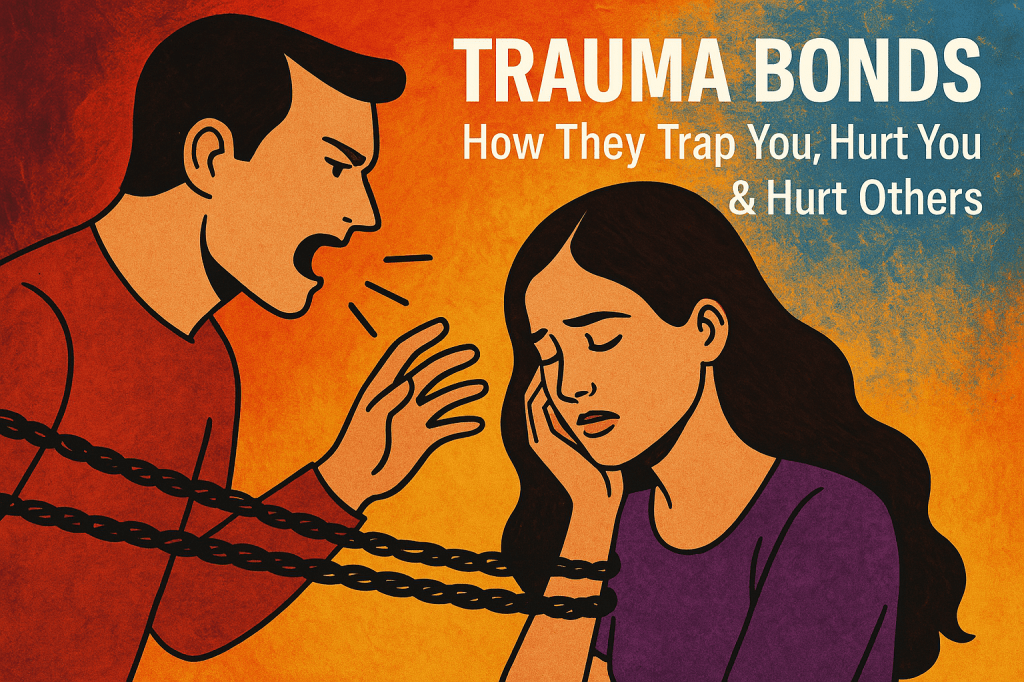
We choose to garb our reactions as passion, destiny, loyalty, and nostalgia. We disguise it in some way that appeals to our mind. This allows us to justify our actions. However, rarely do we name it for what it is: A Trauma Bond.
Trauma bonding affects us—mentally, emotionally, physically, spiritually, and even socially. The effects run deep, are long-lasting and often go unrecognized, because of the way we rationalize our state of mind.
Key Findings from Available Research:
- Prevalence in Abusive Relationships: Studies have shown that individuals in abusive relationships often form strong emotional attachments to their abusers. This is indicative of trauma bonds. For instance, research indicates that intermittent abuse and power imbalances contribute significantly to the strength of these bonds.
- Association with Mental Health Issues: Trauma bonds have been linked to adverse mental health outcomes. These include depression, anxiety, and post-traumatic stress disorder (PTSD). The emotional dependency and manipulation inherent in trauma bonds can severely impact an individual’s psychological well-being.
- Impact of Childhood Experiences: Adverse childhood experiences (ACEs), such as abuse and neglect, significantly increase the risk of developing trauma bonds. This risk develops later in life. The ACE study found that individuals with multiple ACEs face a higher risk for various health and social problems. These include a propensity to form unhealthy attachments.
This article is about letting go of pain that has become part of your identity. It’s about learning to distinguish true affection and love from longing, and attachment from addiction. It is also about not staying in an unhealthy holding pattern, in the hope that things will eventually work out. It is about recognizing that we’re afflicted. It involves learning how to accept it for what it is. It also means understanding how to become trauma free.
What This Article Covers:
- What trauma bonding really is.
- How trauma bonds form.
- How emotional addictions, pain and patterns are created.
- The role of negative emotions.
- The negative effects of trauma bonds.
- How to recognize the symptoms.
- How to overcome this affliction.
- How to deal with people trapped in the trauma bonding syndrome.
Who Should Read This Article
If you see yourself fit any of these descriptions, this article is for you.
- If you can’t detach from people or circumstances that caused trauma.
- If you’ve experienced intense emotions from relationships that ended due to timing, distance, or family pressure.
- If you’re stuck in cycles of self-sabotage, emotional addiction, or toxic patterns.
- If you’re a survivor of abuse, abandonment, or betrayal.
- If you’re seeking a deeper perspective on Trauma Bonding.
- If you’re involved with a person who is afflicted by Trauma Bonding.
- If you’re asking: Why am I habituated to causing myself pain? Why can’t I move on?
About The Author
Sumir Nagar is a seeker, adventurer, storyteller, strategist, professional with deep spiritual convictions. He has lived and worked across four continents and traveled to around forty countries. These experiences give him insights into people, cultures, and lifestyles from across the globe. Sumir has over 30 years of experience in global leadership roles. These roles span finance, compliance, startups, and technology. He now focuses on consulting, human resilience, truth, and emotional clarity.
He writes and podcasts about various topics. These range from life’s gray zones. He speaks about the topics people often ignore. He talks about the spaces between pain and purpose. He discusses truth and illusion. He reflects on success and soul. His work blends real-world grit with timeless wisdom.
- Website: www.sumirnagar.com
- YouTube: SumirTheSeeker
- Instagram: @SumirTheSeeker
- LinkedIn: Sumir Nagar
What Is Trauma Bonding?
Trauma bonding is an emotional and psychological attachment. It is formed not through deep emotional affections alone. Instead, it develops through pain, circumstances, unpredictability, emotional dependency, longing, and even a need for revenge or seeking validation. It’s the feeling of being stuck—unable to let go of someone (or something) that has repeatedly harmed, disappointed, or confused you.
You don’t cling because you’re weak. You cling because the pain feels like purpose. The chaos felt like a connection.
Trauma Bonding – Can It Also Involve Detachment?
Most people associate trauma bonding with clinging, obsession, or an inability to let go. There’s a less visible but equally damaging version of it. This version is emotional disconnection as a survival mechanism. In both cases, trauma is the root. The reaction just looks different.
How Trauma Bonding Affects Us – The Cost of Emotional Addiction
Trauma bonding comes with a heavy cost: mental, physical, emotional, and even spiritual. It hijacks your nervous system. It reprograms your definition of relationships. It puts you through constant cycles of emotional highs and lows, creates anxiety, depression, and obsessive thinking. Your body and mind suffer from chronic stress, exhaustion, and sleep deprivation. You begin to lose your sense of self, sabotaging healthy relationships and repeating familiar pain patterns. This emotional addiction traps you in survival mode. You mistake chaos for connection. You confuse suffering for significance. However, you have the power to choose to break the cycle.
MENTAL IMPACT
Trauma bonding rewires your brain. It conditions you to associate emotional instability with connection. Over time, this creates chronic mental stress and deeply ingrained patterns that are seemingly hard to break.
Obsessive Thinking
- Constantly replaying conversations, scenarios, or “what ifs.”
- Mental fixation on the person or events—even after they’ve left or the events are in the past.
- Fantasizing about reunion, closure, or revenge.
- Inability to concentrate or make clear decisions.
Cognitive Dissonance
- You confuse love and pain.
- You believe conflicting truths: “They hurt me” vs “They loved me”.
- You rationalize red flags to preserve emotional attachment.
- You doubt your own judgment.
Low Self-Esteem & Self-Blame
- You internalize the trauma: “What did I do wrong?”
- You feel unworthy of better treatment.
- You may even believe the toxic bond was the best you’ll ever get.
Anxiety, Depression & Rumination
- Persistent dread, sadness, or numbness.
- Episodes of hopelessness, mood swings, or emotional shutdown.
- Feeling “stuck” in the past or fearing future relationships.
PHYSICAL IMPACT
Trauma bonding doesn’t just affect the mind—it affects the body too. Your nervous system is constantly on high alert, leading to somatic stress, burnout, and even chronic illness. Here is how you’re affected:
Nervous System Dysregulation
- Fight-or-flight mode stays activated. You’re constantly fighting or running away from people and situations.
- Adrenal fatigue from constant emotional tension.
- Chronic muscle tension, jaw clenching, or shallow breathing.
Sleep & Appetite Disturbances
- Insomnia or restless sleep.
- Nightmares or emotionally charged dreams.
- Dietary issues such as overeating, loss of appetite, or emotional binge eating.
Weakened Immune System
- Prolonged cortisol release impairs immunity.
- You get sick more often or take longer to heal.
- Physical inflammation, migraines, or hormonal imbalance.
EMOTIONAL & SPIRITUAL IMPACT
Trauma bonding slowly strips you of emotional clarity and spiritual peace. You feel fractured, lost, or like a ghost of yourself.
Emotional Dependency
- You feel addicted to validation, attention, or presence of undesirable elements.
- Your happiness depends on the behavior or moods of people or situations responsible.
- You fear abandonment more than you desire freedom.
Detachment from Self
- You forget who you were before you encountered such people.
- You stop listening to your intuition.
- You suppress your needs to preserve the bond.
Loss of Identity & Inner Conflict
- You shape-shift to accommodate or keep the association alive.
- You betray your values or boundaries.
- You struggle to trust your feelings again.
Spiritual Disconnection
- You feel disconnected from your purpose, inner peace, or higher self.
- Relationships become a battlefield instead of a sanctuary.
- You doubt the universe, God, or your own soul’s worthiness.
RELATIONAL & SOCIAL IMPACT
Trauma bonds don’t exist in isolation. They impact your relationship with others, yourself, and the world (an outward ripple effect).
Sabotaging New Relationships
- You compare new people to the trauma bond.
- You reject healthy relationships because it feels unfamiliar or “boring.”
- You push people away or test them constantly.
- You are unable to comprehend why people are treating you right for a change.
- You’re always questioning good intent.
Repeating the Cycle
- You unconsciously seek out people who mirror the old dynamic.
- Your nervous system seeks chaos because it seems familiar.
- “Different face, same wound” becomes a pattern.
Social Withdrawal
- You isolate yourself from friends or family out of shame, confusion or simply to avoid discomfort.
- You avoid support because you don’t want to “talk about it again.”
- You stop trusting others—or yourself.
LONG-TERM EFFECTS
If left unresolved, trauma bonding can lead to:
- Complex PTSD (C-PTSD)
- Narcissistic abuse syndrome
- Relational PTSD (difficulty forming healthy bonds)
- Emotional numbness or shutdown
- Delayed grieving or trauma processing years after the bond ends
Trauma bonding doesn’t just hurt—it rewires you, in a way that’s not healthy. It teaches your body that instability is intimacy, that longing is love, and that suffering is your role. Unless you allow yourself to heal, you’ll carry that pattern into every future relationship, situation, and decision.
But you can break it, once you see it clearly. You can rewire it, once you name it. And you can reclaim everything that was taken from you, once you choose yourself.
Why Trauma Bonding Happens
Trauma bonding occurs when we stay attached or stay affected by intense emotional experiences that make us confused. Those experiences often involve pain, unpredictability, or abandonment. This leads to a mix of emotions encompassing safety or belonging. It often forms through a repeated cycle of affection followed by neglect, creating confusion and emotional dependency. Your brain starts to crave the inconsistency. It releases dopamine during moments of connection. It releases cortisol during disconnection. This pattern makes the relationship feel addictive. For many, unresolved childhood wounds and low self-worth make this dynamic feel familiar. It is even comforting and reinforces the illusion that suffering is a necessary part of your existence.
Intermittent Reinforcement
Relationships tend to be deep and profound experiences, regardless of the level of seriousness. In fact the most addictive relationships are inconsistent—alternating between affection and absence, love and coldness. This keeps your nervous system on edge and craving resolution. You’re always waiting in anticipation, with bated breath and constantly thinking about it. As a result clarity of thought is left by the wayside.
You can read more details in a previous article I wrote: Closure – The Truth You’ll Never Get From Them.
Brain Chemistry
Your brain becomes addicted to the emotional roller-coaster. In this article, I will briefly mention the impact on our brain. You can read more details about this in a related article. It is called System Overload – How to Optimize Your Brain’s Operating System for Clear Thinking.
- Cortisol rises during pain.
- Dopamine spikes during reconnection.
- Oxytocin bonds you during intimacy.
- It’s not love—it’s withdrawal and reward.
Unresolved Childhood Wounds
If love in childhood was conditional, absent, or unpredictable, the adult mind seeks the familiar—even if it’s painful.
Scarcity and Emotional Starvation
When someone makes you feel special, seen, or safe—and then pulls away—the emotional vacuum left behind is profound. You chase the feeling, thinking it’s the person.
Trauma Bonding Without Toxicity – When Relationships End, But the Bond Doesn’t
Trauma bonding doesn’t always stem from abuse—sometimes, it’s born from a deep emotional connection that couldn’t survive circumstances. When a relationship ends due to timing, distance, family opposition, or personal struggles, the emotional connection often lingers. There’s no closure, no betrayal—just absence. You’re left bonded not necessarily to a person, but to the memory of what could have been. The story feels unfinished, the emotions unresolved, and the hope quietly alive—making it even harder to let go.
Not all trauma bonds come from abuse. Some come from unfulfilled expectations:
- A relationship ended by timing, geography, or family pressure.
- A person who loved you but couldn’t choose you.
- A connection that felt like destiny but never materialized.
What Traps You:
- The belief that this could have been everything
- The romanticization of what could’ve been
- The hope that they’ll come back one day
This isn’t a trauma bond to a person—it’s a trauma bond to a fantasy.
Short-Term Relationships. Long-Term Trauma.
Some of the most haunting bonds are born in the briefest encounters. It doesn’t take years to form a trauma bond—just a moment that hits where you’re most vulnerable. A short-lived connection, especially the ones rooted in the need for physical intimacy, can awaken deep emotional needs. These needs include feeling seen, desired, and chosen—even if only for a moment.
What was meant to be “casual” becomes more than “just casual”. It changes not because of what happened. Instead, it happens because of what it stirred inside you. And when the other person pulls away, disappears, or treats it like it means nothing, the emotional fallout is devastating. The pain isn’t just in being left—it’s in feeling foolish when it ends.
You were vulnerable. Open. Real. And when that was met with indifference, dishonesty, or deception, it shook your self-worth. The betrayal wasn’t just in their absence, but in how your tenderness was treated like naivety. The bond may have been brief, but the wound it left behind is anything but. It’s not the time that matters. It’s the intensity.
Scenarios:
- Ghosting after Love-bombing.
- Breadcrumbing by popping up just when the healing process starts.
- Situationships that blurred emotional boundaries or then fulfilled a physical need.
- A rebound that awoke something deep—but then ended.
- “It felt like fate” but ended without closure.
Beyond People – Trauma Bonding with Behavior, Patterns & Identity
Trauma bonding isn’t limited to people. You can be bonded to behaviors, emotional patterns, or even versions of yourself shaped by pain. You might stay loyal to chaos, overgiving, or self-sabotage because they feel familiar and safe. Roles like “the fixer,” “the martyr,” or “the survivor” can become part of your identity. It becomes hard to imagine who you are without the struggle. Over time, the pain becomes a comfort zone—not because it’s right, but because it’s what you’ve always known.
You can be trauma bonded to:
- Behavior cycles (e.g., overgiving, self-sabotage, chaos).
- Life roles (e.g., fixer, martyr, victim).
- Environments (e.g., toxic workplaces, families, friendships, or undesirable associations).
- Pain itself (e.g., bonding with failure, rejection, or grief).
Why? Because pain becomes your compass. Familiar pain feels safer than unfamiliar peace, love, affection and something truly meaningful.
How Negative Emotions Reinforce Trauma Bonds
Negative emotions like anger, hate, guilt, regret, and shame can silently reinforce trauma bonds. They keep you emotionally tethered to the person or experience. These emotions cause the connection to sustain through obsession, self-blame, or a need for closure or revenge. You’re still emotionally invested—just from the other side of the spectrum. Instead of releasing the bond, these feelings deepen it, turning pain into a loop that’s hard to escape.
Hate and Vengeance
Obsession need not just be our need for love and affection. When things go horribly wrong, we feel jaded and those positive feelings turn to intense negative emotions. We remain obsessed—just in reverse. The need for revenge keeps you tethered to the very person or events you want to forget. We don’t realize this. If they remain your motivation, they continue to have power over you. This motivation is based on extreme negativity.
We Permit Manipulation
We are manipulated because we permit ourselves to be manipulated. Although you are not to blame, feelings of guilt arise. This lack of self-respect becomes the chain you willingly wear.
Low Self-Esteem
You believe:
- “I deserved this.”
- “This is the best I’ll ever get.”
- “Maybe pain is what love looks like.”
It’s a wound disguised as worth.
How Trauma Bonds Impact Future Relationships
Trauma bonds can severely sabotage future relationships by distorting your sense of love, trust, and emotional safety. You struggle to open up. Struggle to embrace what could potentially go well. You might chase intensity over stability. You may also compare new partners to the emotional experiences of the past. Healthy relationships feel unfamiliar or even boring, while chaos feels like chemistry. You become averse to emotional commitments. Without healing, you risk repeating the same dynamics—carrying your past pain into a new but healthy connection. Instead you may seek short term, frivolous and casual encounters, because at first they carry no emotional investment. And that only become a pattern, until we realize that it damages us more than it helps us.
- You shut down emotionally, still haunted by the past.
- You reject stability, because drama feels more like “home”.
- You compare new people to the emotions of your trauma bond.
- You sabotage love, fearing vulnerability or expecting betrayal.
- Your vengeance and lack of trust is consciously or unconsciously deflected onto the new relationship. It is driven by the need to lash out at a caring person. This happens simply because you couldn’t extract that from the person who wronged you.
You’re not afraid of emotional connect, you’re wary of it. and shy away from expression. You’re afraid of repetition. And yet, unknowingly, you recreate it, by playing the “one-step two-step” game.
Symptoms of Trauma Bonding
The symptoms of a trauma bond often feel like a real emotional connect but are rooted in emotional captivity. You obsess over someone or something that hurt you. You justify or minimize their behavior. You feel unable to leave and crave their validation. This happens even when you’re suffering. Your mood swings between longing, anger, guilt, and confusion—feeling addicted to the emotional highs and devastated by the lows. Despite knowing the relationship is unhealthy, you feel emotionally tethered, often mistaking intensity for intimacy and pain for passion.
Here are the telltale signs:
- Obsessing over someone who hurt or left you.
- Romanticizing past moments while ignoring red flags.
- Checking their socials, replaying old texts.
- Comparing everyone new to the past.
- Believing that you’ll never feel something that intense again.
- Thinking that you failed the relationship.
- Sabotaging new connections out of fear, guilt, anger, vengeance or nostalgia.
How to Break a Trauma Bond
Breaking a trauma bond begins with recognizing it. See it for what it is. It is an emotional addiction rooted in pain, fear, and unmet needs. The healing process involves going no-contact or setting strong boundaries. You need to rewrite the internal story that seems to define the bond. Allow yourself to feel the emotional withdrawal without giving in to it. It’s about reconnecting with your identity. You need to rebuild your self-worth. Heal the wounds that made the bond feel necessary in the first place. True freedom is about remembering who you were before the pain. Choose yourself every single day.
Here is what you need to do:
- Call It What It Is: Not love. Not fate. Not unfinished business. Call it what it is: a Trauma Bond.
- Go No Contact (Or Radical Emotional Boundaries): Block. Mute. Delete. If contact is absolutely necessary, keep it factual and brief.
- Rewire the Narrative: Write out every painful moment—not to relive it, but to remember reality when nostalgia lies.
- Feel the Withdrawal: The pain is real. But it’s not a sign you should go back. It’s a sign that your nervous system is recalibrating.
- Do Inner Healing Work: Journal, see a trauma-informed therapist, do inner child and shadow work. Ask: “What was I really looking for in them?”
- Rebuild Your Identity: Discover who you are without needing someone else to define your worth.
- Let Go With Grace, Not Closure: They may never apologize. You may never understand fully. Closure is not what they give you—it’s what you give yourself. I wrote an article for a deep dive into “closure.” Read “Closure – The Truth You’ll Never Get From Them.”
Those Strings – How Staying Connected Keeps You Emotionally Trapped
— The Silent Ways Trauma Bonds Stay Alive Long After It’s Over
Staying connected—whether directly, indirectly, physically, emotionally, or virtually—will only prolong a trauma bond, even when the relationship has “officially” ended. This connection doesn’t have to be direct or intentional. In fact, even passive or one-sided connections can include activities like watching their stories. They can also involve checking their status or holding onto shared playlists. These actions can keep the emotional wound open and the bond alive.
Let’s break it down by type of connection:
1. Direct Connection – The Most Obvious Trap
A. Ongoing Communication
- Texting, calling, or replying to their messages
- Occasional “check-ins” that lead nowhere
- Trying to stay “friends” for no real purpose
Why it hurts: Every message or call is a trigger, reinforcing the cycle of craving and reward.
B. In-Person Meetings
- Bumping into them “accidentally on purpose”
- Meeting under the guise of closure or casual catch-ups
- Continuing physical intimacy, even if you’re emotionally broken
Why it hurts: Seeing them reignites old feelings. It causes confusion and keeps your body and nervous system in a state of false intimacy. Your mind may say it’s over, but your body registers reconnection as attachment.
2. Indirect Connection – The Silent Reinforcement
A. Watching Them Online
- Checking their Instagram stories, posts, or last seen
- Tracking who they’re dating, liking, or interacting with
- Replaying their voice notes or videos
Why it hurts: Your brain doesn’t differentiate between real interaction and perceived presence. Even passive observation triggers memory, emotion, and false closeness.
B. Keeping Reminders Around
- Holding onto gifts, photos, clothes, or souvenirs
- Listening to “your songs”
- Revisiting messages or saved chats
Why it hurts: These objects or digital footprints become emotional triggers. They anchor your identity to the bond and delay detachment by keeping the past emotionally present.
C. Shared Circles and Mutual Spaces
- Talking about them with mutual friends
- Attending the same events, hoping to run into them
- Asking others about them “just out of curiosity”
Why it hurts: Even if they’re not physically there, your emotional attention stays fixated. You remain tethered by hope, comparison, or what-ifs.
3. Internal Connection – The Most Difficult to Cut
A. Fantasy & Mental Replays
- Imagining reunions, conversations, apologies
- Writing unsent messages in your head
- Holding onto the version of them that never existed fully
Why it hurts: Internal connection often lasts longer than real-life contact. It keeps you stuck in an emotional loop. You find yourself fighting with a memory. You might bargain with a ghost or wait for closure from someone who isn’t coming back.
Why All These Forms of Connection Keep You Stuck
Trauma bonding thrives on inconsistency, unresolved emotions, and the illusion of hope.
Every interaction—no matter how small—acts as emotional reinforcement. It tells your brain: “They’re still around. The story isn’t over.”
Whether it’s:
- A late-night text.
- A story view.
- A photograph.
- Or a moment of daydreaming…
Each one reactivates the bond. Each one pulls you back. And each one delays the healing that comes from true disconnection.
The Truth – You Can’t Heal What You’re Still Attached To
Cutting the cord isn’t just about blocking them—it’s about unhooking your mind, body, and heart from their presence.
You must cleanse every entry point:
- The messages.
- The reminders.
- The fantasies.
- The illusion of “someday”.
Because healing starts the moment you stop feeding the bond. And the peace you’re looking for doesn’t live in their return. It lives in your release.
Two Sides of the Same Coin – Attachment vs. Detachment
Most people associate trauma bonding with clinging, obsession, or an inability to let go. Yet, there’s a less visible but equally damaging version of it. This is emotional disconnection as a survival mechanism. In both cases, trauma is the root. The reaction merely looks different.
- Attachment-based trauma bonding occurs when you remain emotionally hooked to someone who hurt you—longing for validation, replaying memories, craving closure.
- Detachment-based trauma bonding occurs when you emotionally shut down to cope with the pain. You might still be bonded through avoidance, numbness, bitterness, or emotional withdrawal. This is not to protect the other person, but to protect yourself.
In both cases, you’re still bound to the trauma. Whether you’re obsessing over them or building walls to feel nothing at all, the connection still holds power.
Signs of Detachment-Based Trauma Bonding
- You feel numb when you think about them—but they still take up mental space
- You avoid forming new attachments for fear of repeating the pain
- You speak about them with anger or indifference—but it masks unresolved grief
- You don’t miss them, but you’re still stuck emotionally—unable to trust, love, or open up
- You find yourself emotionally disconnected from others because of what one person did
Why This Happens
Detachment often develops when:
- The trauma was ongoing or layered.
- You were deeply hurt but couldn’t leave.
- Your nervous system had to dissociate to survive the emotional chaos.
- You internalized the belief that closeness = danger or disappointment.
This is trauma bonding through avoidance. In this situation, your bond isn’t with the person. Instead, it is with the defense mechanism that kept you from breaking down.
Healing Requires Reconnection—with Yourself First
Detachment is a wound disguised as strength. Healing it requires:
- Rebuilding trust in your emotional world.
- Letting yourself feel what you once had to bury.
- Learning to stay present with vulnerability, without fear.
- Understanding that numbness is not peace—it’s protection.
Trauma bonding can absolutely take the form of detachment. In both obsession and avoidance, you remain emotionally captive. The path to healing isn’t to run from the pain. It isn’t to fixate on it. It’s to meet it, feel it, and finally, release it.
The Bond Was Real – The Pain Was Deep. But It’s Time to Be Free
When you’re prepared to walk out of a trauma bond and stop being the victim, say this to yourself. “I’m not crazy. I am not weak. I am not broken. I was just bonded to something that once made me feel alive—even if it eventually left me shattered. Healing doesn’t mean forgetting. It means saying: “Thank you for the lesson. But your chapter is over.”
Is Denial Emotional Armor? – Why People in Trauma Bonds Can’t See the Trap
People trapped in trauma bonds live in a state of denial—not out of ignorance, but out of emotional self-protection. Denial becomes a survival strategy, allowing them to justify pain, reframe neglect, and reinterpret emotional abandonment as complexity or depth.
But beneath that denial often sits a cocktail of powerful emotions—guilt, anger, and vengeance—that only reinforce the bond further. Guilt makes you believe you’re to blame for the dysfunction or allowing yourself to be exploited. Anger keeps you fixated on the person or the fantasy of justice. And vengeance masks heartbreak with obsession, keeping the past emotionally alive. In this way, denial becomes emotional armor. It shields you from the truth. It also protects you from the collapse of the fantasy that once made you feel seen.
Common Signs of Denial in Trauma Bonding (and What Fuels Them)
- “It wasn’t that bad.” — Guilt makes you feel like you are exaggerating or too sensitive
- “They didn’t mean to hurt me.” — Excusing patterns to avoid facing betrayal
- “They’re just going through a lot.” — Denial cloaked as empathy
- “If I leave, I’m abandoning them.” — Guilt as a tether that replaces healthy boundaries
- “I’ll show them what they lost.” — Vengeance that looks like strength, but keeps you stuck
- “They owe me closure.” — Anger that keeps emotional cords alive, demanding justice from someone incapable of giving it
- “We just need to fix a few things.” — Hope used as a disguise for fear of letting go
- “No one understands our connection.” — Romanticizing pain to justify staying in it
- “They’re broken—I can heal them.” — A savior complex rooted in guilt and emotional responsibility.
A Relationship With Someone Who’s Still Tied to Their Past – The Silent Strain of Trauma Bonding in New Relationships
Being in a relationship with someone who is still emotionally connected to trauma bonds is challenging. They may or may not realize their situation. It is like trying to build a home on shifting ground. No matter how much love, presence, or reassurance you offer, a part of them remains emotionally unavailable. They are tethered to a past that still owns their heart. It owns their triggers and sometimes, their identity.
You notice it in small, painful ways: the faraway look when they’re quiet. There is a hesitation to fully open up. They flinch at consistency like it’s unfamiliar. You give them safety, but they crave chaos. You offer love, but they miss intensity. You become the emotional stabilizer in a storm they never chose, yet never fully escaped.
They may liken you—silently or aloud—to someone who hurt them. Or worse, they may project old wounds onto you. They know you’re being treated unfairly and therefore wait for you to disappear. They fear you will betray or fall short like the one who came before. Even in your kindness, they find ways to test your loyalty. They push you away because healthy love doesn’t feel “real.” They’ve been conditioned to associate love with pain.
It’s heartbreaking to be the one offering a future, while they’re still emotionally grieving a past. And if they haven’t healed, you begin to feel like a placeholder. You are never quite enough. You are never fully chosen, no matter how much you give.
The truth is: you can’t outlove someone’s trauma bond. They have to be willing to see it, name it, and do the work to break it.
Until then, loving them feels like chasing a heart that’s already spoken for. It is spoken for by a memory, a ghost, or a wound that still bleeds under the surface.
What you can do is shower affection, stay committed and from time to time, show them how they’re trapped. As I say this, I also caution you. This may be the most selfless act of love. However, it will probably not be valued. It may even be turned against you. Be fully prepared for this.
A Daunting Dilemma – Try to Show Them the Truth
A relationship with someone who’s still emotionally entangled with their past is already hard. But trying to point out that their attachment is harming your relationship? That’s when things get heavy. And lonely.
At first, you try to be understanding. You rationalize the emotional distance, the unpredictability, the way they shut down or bring up “what used to be.” You tell yourself they need time. Space. Safety.
But eventually, you see it clearly: they’re not here—not fully. A part of them still lives in the past. Still reminiscing or in contact with people who weren’t good for them. Still clinging to a story that continues to rewrite your present.
So you’re hurting, feel inadequate, are frustrated and you gather the courage to say something.
You tell them: “I feel like your past is still affecting us.”
And that’s when the shift happens. Sometimes, they get defensive. Sometimes, they accuse you of being insecure, jealous, or not understanding their pain. Sometimes, they shut down completely—silence becomes the response, and distance becomes the punishment. And sometimes, they admit you’re right… but they don’t know how to let go.
You begin to feel like the bad guy—for daring to ask for presence, for connection, for truth.
It hurts deeply. You’re not asking them to erase their past (none of us can). You’re just asking them to stop letting it run your future together.
And yet, love can’t thrive where ghosts still live. You want to build something real, but they’re still haunted by what was. You try to love them forward, but they’re still anchored backward.
And the hardest part? Sometimes they don’t even realize they’re still holding on. But sometimes they do and choose to remain in denial, attack you and accuse you of being “too controlling.”
You’re left loving someone who is half-here and half-there. You stand fully in the now. You hope they’ll finally choose this moment over the memory.
How to Protect Yourself When the Person You’re With Is Still Stuck in a Trauma Bond
A relationship with someone who’s still emotionally tied to a past they haven’t let go of is heart-wrenching. You’re offering a future to someone who is still emotionally living in the past. You see their goodness, their pain, and their potential. You want to be their peace. But you slowly realize that love alone isn’t enough to untangle them.
Here’s how you can deal with this dynamic without losing yourself in it:
- Recognize What’s Yours to Carry—And What Isn’t: You cannot compete with a ghost. You cannot heal wounds you didn’t cause. Your job is not to rescue them—it’s to love them with clarity and boundaries, not sacrifice. Know that their inability to be present isn’t a reflection of your worth, but of their unresolved past.
- Speak Your Truth Gently, But Firmly: Say what you see. Lovingly, but directly. “I feel like part of you is still somewhere else, and it’s hurting our connection.” Be calm, not accusatory, even though its hard. Despite the questions, create an atmosphere of trust. This will allow the answers to flow naturally. Also, invite awareness to how damaging it really is to both. Whether they’re ready to face it is not your responsibility, but your voice is the mirror they’ve been avoiding.
- Don’t Shrink Yourself for Their Wounds: Don’t dim your emotional needs to avoid triggering theirs. Don’t accept half-presence just because you know their story. Love requires mutual presence, not emotional martyrdom. If you start silencing your own needs to accommodate their trauma, you’re slowly disappearing.
- Observe Their Response to Truth: Do they acknowledge your feelings or deflect them? Do they show a willingness to address and heal or avoid the conversation? Do they lash out in anger when these topics come up? Do they accuse you? Their reaction tells you everything—not about you, but about their capacity to build something real with you.
- Set Emotional Boundaries: You have a right to say: “I won’t carry the weight of a past that’s not mine.” “I deserve to be with someone who’s fully here. And you will never be here if you choose to stay tethered to your past.” Boundaries are not ultimatums—they’re protective truths.
- Encourage Healing: Support their journey. Encourage them to seek help, to reflect, to do their inner work. You can walk beside someone. You can be the shoulder to lean on. You can even carry them for a while. However, you can’t walk for them.
- Prepare to Let Go If They Choose to Stay Stuck: If they repeatedly choose the past over your present, they are showing that they don’t value you enough. You should consider letting them go. Because being with someone who can’t see you through the fog of their trauma is a slow emotional death.
The DNA of a Trauma Bonding Trigger – Who They Are & How They Operate
The ones who cause trauma bonds, have a distinct emotional signature. Whether they act with intent or ignorance, they share a behavioral and psychological blueprint. This is a kind of emotional DNA. It makes them especially effective at hooking into your insecurities. They confuse your instincts and quietly hijack your self-worth.
They may not always be cruel. In fact, they’re often charismatic, emotionally complex, and even broken in ways that mirror your own wounds. But make no mistake: their behaviors leave behind a trail of emotional damage. They cause confusion and invisible scars—even if they never raise their voice or lay a hand.
Here’s what’s often in the DNA of someone who causes trauma bonding:
- Emotional Inconsistency: They swing between warmth and withdrawal, interest and indifference. You never know which version of them you’re going to get. This unpredictability creates an addictive cycle of hope and anxiety. “They’re not always like this.” becomes the excuse you use to stay.
- Charm Without Accountability: They know how to win you over. They say all the right things. But when it comes to showing up consistently or taking responsibility, they vanish or deflect. They apologize only enough to keep you emotionally invested. You fall for their potential—not their pattern.
- Deep Wounds They Haven’t Faced: Many of them are carrying unresolved trauma, abandonment issues, or emotional baggage of their own. But instead of healing, they bleed on the people who love them. They bond through brokenness—but don’t take responsibility for repair. They keep you around by making you feel responsible for their healing.
- Emotional Control Disguised as Vulnerability: They overshare, trauma-dump, or play the victim to earn your empathy. They weaponize their pain to excuse their behavior. You end up carrying their wounds while ignoring your own. You feel like the “strong one,” but you’re actually being emotionally manipulated.
- They Mirror You, Then Withdraw: In the beginning, they reflect your dreams, values, desires. It feels like you’ve found a soulmate. Then, slowly, they change. Or disappear. You’re left grieving someone who may have never fully existed. You don’t miss them—you miss who you thought they were.
- Entitlement Without Effort: They expect love, loyalty, forgiveness—even when they’ve done nothing to earn it. They want access to your heart but offer little stability in return. You find yourself overgiving, over-explaining, overextending—just to keep them close. You become exhausted trying to be “enough” for someone who never shows up fully.
- Emotional Cowardice: They ghost instead of confront. They manipulate instead of communicate. They say “you’re too sensitive” instead of owning their impact. And each time, you make excuses for them instead of asking why you’re tolerating it.
- Just Enough to Keep You Hooked: They never give you full love, but never fully leave. They know when to text, when to flirt, when to breadcrumb—just to keep you in orbit. They never commit, but won’t let you go either. You become addicted to the crumbs, because it’s better than nothing.
- They Keep Coming Back for More: You gave in once or repeatedly in the past. Now, they are unwilling to let go. They may “just be” in your neighborhood, or they may “just be’ thinking of you. They will try to remind you of places you’ve been. Maybe you fixed them a meal. Perhaps you caught a movie together. Read between the lines. By reaching out periodically they are hoping to catch you at a weak moment. All they want is to use you again, emotionally or intimately.
Why You Should Not Feel Guilty
They give just enough to keep you hopeful, but never enough to make you feel secure. And somewhere in that chaos, you started blaming yourself for the instability they created.
And here’s the hard truth: You’re not at fault for what they did. However, you are responsible for what you allowed to continue.
That doesn’t mean you’re weak. It means you were vulnerable, open, hopeful—and maybe a little bit in denial. You ignored the red flags, justified the inconsistencies, and held onto potential instead of reality.
Why We Let It Happen (And Stay)
You Were Chasing the Initial High: In the beginning, they made you feel like you were safe. Their attention felt like validation, maybe even love. And every time they withdrew, you convinced yourself that if you just tried harder, that version of them would return.
You Confused Intensity With Intimacy: The roller-coaster felt passionate, deep, soul-level—even though it was actually emotional turbulence. You mistook chaos for connection because your nervous system was hooked on unpredictability.
You Were Afraid to Be Wrong: Admitting the truth would mean facing the pain. You gave your heart to someone who never fully valued it. So you kept rewriting the narrative to avoid collapsing the fantasy.
You Believed You Could Save Them: Their pain spoke to your empathy. You saw the broken parts in them and thought your love could heal it. You stayed out of loyalty, out of hope, and maybe out of guilt.
You Betrayed Yourself Quietly, Repeatedly: Each time you stayed after a boundary was crossed, you betrayed yourself. Each time you silenced your gut, you betrayed yourself. Each time you forgave without change, you betrayed yourself. You told yourself this was love. But really, it was self-abandonment.
Owning Your Role Isn’t About Blame—It’s About Power
Yes, they hurt you. Yes, they manipulated, ghosted, gaslighted, or used you. But they only did what you let them keep doing. Taking accountability isn’t about beating yourself up. It’s about reclaiming your agency. Because if you had the power to keep choosing them—You also have the power to finally choose yourself.
Conclusion – It Was a Trauma Bond—Not a Love Story. And Now, It’s Time to Set Yourself Free.
Trauma bonding is one of the most silent, deceptive forms of emotional captivity. It is difficult to recognize because it doesn’t always come wearing the face of cruelty. Sometimes, it wears charm. Familiarity. Soft apologies. Deep eye contact. Sometimes, it feels like the person who “got away” or the one who “almost stayed.”
Sometimes, it’s not even a person anymore—it’s a pattern. A wound. A memory. A story we keep rewriting, hoping for a different ending.
And the most tragic part? We often don’t know we’re bonded by trauma until we’re breaking ourselves to keep something broken alive.
The person who created the bond might have acted out of their own unhealed wounds. They may have done so through inconsistency. Manipulation or indifference could have been disguised as love. But the power to stay, return, justify, and abandon ourselves for their validation? That power was always ours.
For those who are stuck in it: you must understand that your pain is not proof of love. Your longing is not loyalty. The intensity you feel is not connection—it’s chemical confusion. You’re not mourning the person—you’re mourning the part of you that thought this was working for you.
Let’s call it what it was.
It wasn’t fate. It wasn’t “deep.” It wasn’t complicated love.
It was a trauma bond—a cycle of emotional hunger and temporary relief.
A bond born in inconsistency, confusion, and unmet needs.
A connection that made you question your worth, shrink your voice, and call pain “passion.”
You may have stayed because you believed they’d change.
You may have stayed because they made you feel needed, seen, or even special—once.
You may have stayed because walking away felt like failure.
But staying in emotional captivity isn’t loyalty.
And missing them isn’t proof of love.
It’s proof that something inside you still needs healing.
But here’s the truth that changes everything: you are not powerless. You don’t need their apology. You don’t need more time. You don’t need closure from them. You just need to choose you. Over and over again—until the choosing becomes freedom, and the freedom becomes peace.
- You are allowed to outgrow the stories that broke you.
- You are allowed to walk away from people who keep you small.
- You are allowed to heal loudly, fully, unapologetically.
Because what hurt you doesn’t get to define you. Your healing does. Your clarity does. Your courage does.
Let today be the day you start calling it what it really is: A lesson. A redirection. A turning point.
And maybe the most powerful part of your story… is the part where you finally let go. Not because it didn’t matter—but because now, you do.
And for those who love someone trapped in a trauma bond: your role is not to heal them. Nor is it to save them. Do not wait for them to choose you. You are not their rescue mission. You are your own story, and you deserve to be loved by someone who is emotionally present, not emotionally possessed.
Some bonds feel eternal because they touched our deepest cracks. But even if they were real, even if they left a mark—you are still allowed to outgrow them. You are allowed to say, “This shaped me, but it no longer defines me.”
Let go. Not because it didn’t matter. Let go because you matter more.
The story doesn’t end when they leave. The story begins when you return to yourself.
Call to Action – Share Your Healing
If this article resonated with you:
- Share it with someone who’s hurting.
- Bookmark it for the days you miss them.
- Use it as a guide to write your goodbye letter—to the person, the pain, or the past version of you.
You deserve peace. You deserve real love. And you don’t need to bleed for either.
For more insights on mindset, mental clarity, and personal transformation, visit: www.sumirnagar.com
Follow SumirTheSeeker on Social Media for Daily Wisdom & Insights: YouTube, Instagram, Twitter, LinkedIn, and Facebook – @SumirTheSeeker
 Sumir Nagar
[…] you repeatedly dismiss your pain because “they didn’t mean it,” you’re telling yourself your emotions aren’t worth defending. That’s not empathy—it’s […]
LikeLike
Spot on, thanks for commenting and sharing your work.
LikeLike
[…] Trauma Bonds – The Trap, The Pain, The Hurt & How to Break Free […]
LikeLike